Is the Jackery Explorer 100D Worth Packing for Japan?
Jackery's new 96Wh power bank clears the 100Wh airline limit. Specs and price from Jackery's listing, and whether it beats a cheaper bank for a Japan trip.

Published on 5 min read
On this page
Jackery’s newest power bank launched everywhere at once this month: in-store at 30 Costco locations on November 7, online through a Walmart-exclusive bundle on November 15, and on Jackery’s site with a product page that leads straight into a watt-hour number most shoppers never think about. The Explorer 100D is Jackery’s smallest power station yet, and it’s pitched directly at travelers. We covered the FAA and airline rules that govern any power bank in a carry-on a couple weeks ago. Here’s whether this specific one, at its current price, earns a spot in a Japan packing list over the bank you can already buy for a third of the cost.
The specs, straight from Jackery’s listing
Pulled directly from Jackery’s product page, not a retailer’s summary:
| Spec | Explorer 100D |
|---|---|
| Battery capacity | 96Wh (LiFePO4) |
| Rated lifespan | 3,000 cycles to 80% capacity, up to 8 years of use |
| USB-C output | Up to 140W on the primary port |
| Total output | 158W combined across both USB-C ports and the USB-A port |
| Charging input | Up to 140W wall, 100W solar, 100W car |
| Solar recharge time | 0 to 80% in about 1.7 hours at 100W input |
| Dimensions | 4.67 x 3.25 x 3.37 in |
| Price (Jackery.com) | $119 standalone, $229 for a two-pack |
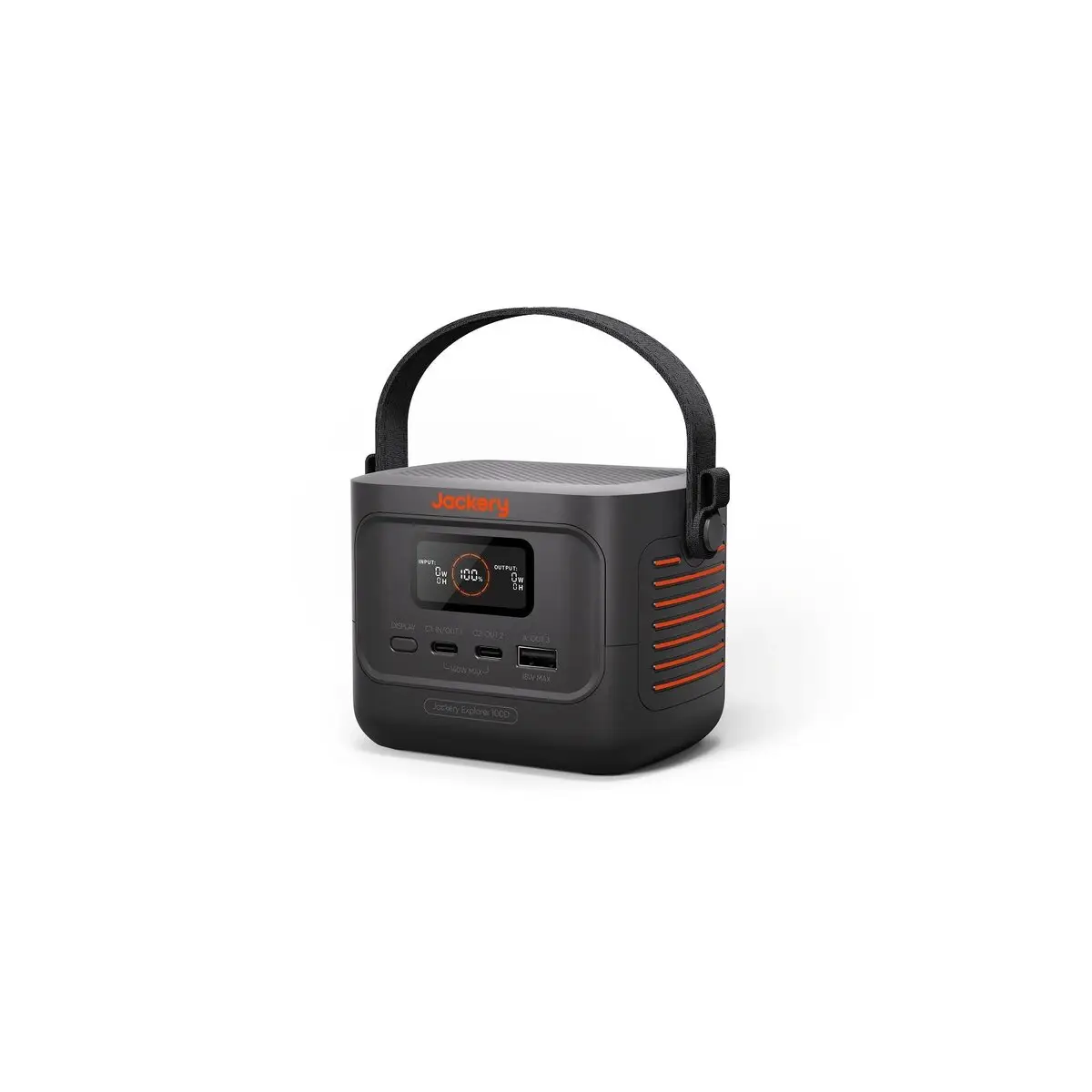
The product photos show the port layout clearly: one USB-C port doubles as the charging input and an output, a second USB-C is output only, and those two share the 140W ceiling between them. The single USB-A port is capped at 18W, which is what gets you to 158W total when everything’s plugged in at once.
Jackery doesn’t list a weight on its product page, an odd gap for a device marketed on being pocket-sized. Independent tech coverage from launch day puts it at about 1.9 pounds (850 grams), which tracks with the dimensions: small enough for a jacket pocket, not light enough to forget it’s there.
Jackery’s charge estimates: about four full charges for an iPhone 17 or Galaxy S26-class phone, or roughly one full charge for a 14-inch MacBook Pro. For a day of maps, photos, and a mobile Suica card, that’s days of phone charging from one unit. For a laptop on a long shinkansen leg, it’s one top-up, not a full workday’s worth of power.
The flight-rule pitch, checked against the actual rule
Jackery’s product page has a section titled “Air-Travel Friendly” that says the 96Wh capacity sits under the typical 100Wh airline carry-on limit, with a footnote telling you to confirm with your specific airline since policies vary. That’s an accurate pitch and not a new rule Jackery invented: it’s the same FAA-derived 100Wh threshold that JAL, ANA, and most carriers flying to Japan already use, the one we broke down airline by airline in our power bank rules post. At 96Wh, the Explorer 100D clears that line with 4Wh of margin, no airline approval step required, same as a standard 20,000mAh phone bank.
That margin is tighter than it sounds. A fully charged battery reads a little above its rated capacity on some meters, and airline staff go by the printed Wh rating, not a measurement. Jackery prints 96Wh on the unit itself, so the margin holds on paper regardless. It’s a comfortable clearance, just not a wide one.
What it costs right now, and the catch
Jackery’s site lists the Explorer 100D at $119 for one unit or $229 for a two-pack. That’s higher than the price tech outlets reported at launch on November 2: $99 standalone through Walmart starting November 15, with a $179.99 two-unit bundle. Three weeks in, the price on Jackery’s direct site doesn’t match what was advertised through the retail launch, so check Walmart’s and Costco’s current listings before paying Jackery’s site price.
There’s a second catch worth flagging plainly: as of this writing, both the single unit and the two-pack show zero inventory on Jackery’s site, meaning you can’t buy either one directly from Jackery right now. Costco and Walmart are the live retail channels for this launch.
Is it worth it over a basic power bank?
Here’s the honest comparison. A generic 20,000mAh lithium-ion bank, the size most people already travel with, runs about 74Wh by the standard conversion and costs $25 to $40 on Amazon. The Explorer 100D holds more capacity at 96Wh for roughly three to four times the price. For a phone, a mobile Suica card, and photos on a single travel day, a cheap bank already does the job, which is exactly what we recommended in the power bank rules post.
Where the Explorer 100D’s price starts making sense is everything past phone-charging. Its 140W port can fast-charge a laptop, something most $30 power banks can’t do at all since they top out around 18 to 22W. The LiFePO4 battery chemistry is rated for roughly ten times the charge cycles of the lithium-ion cells in a typical cheap bank, which matters if this is going on more than one trip. And the solar and car-charging input options are a genuine feature for anyone doing more than city travel, not something a basic phone bank offers at any price.
For a family of five, one unit isn’t a replacement for the small phone banks the kids would carry, the three output ports only cover so much at once. What it does change is the gear a laptop-carrying adult would otherwise pack separately: a 140W laptop charger and a phone bank both, instead of one device that does both jobs and still has a USB-A port free for a third gadget.
The verdict
For a standard family trip where phones and a tablet are the only things that need charging, a $30 power bank in the 20,000mAh range covers the day and clears the same airline rule with less money on the table. The Explorer 100D earns its premium specifically for someone also carrying a laptop or camera gear, or who wants the longer battery lifespan for repeat use rather than a single trip. Given that it’s not currently buyable straight from Jackery and the price has already moved since launch, compare Costco’s and Walmart’s current listings before deciding either way.
This post has affiliate links. How this works