PayPay Dome or Tokyo Dome: Which Baseball Night Is Worth Your Yen
Our first Japanese baseball game was at Fukuoka's PayPay Dome, not Tokyo Dome. Real ticket prices and a real head-to-head between the two domed stadiums.

Published on 6 min read
On this page
We’ve already written about Tokyo Dome three times over on this site, a family evening game, the real beer prices, a Yomiuri Giants night. What we hadn’t mentioned yet: our actual first baseball game in Japan wasn’t in Tokyo at all. It was at PayPay Dome in Fukuoka, a Hawks game, just the two of us, more than a year before any of those Tokyo Dome visits happened. Two real domed stadiums, two different teams, worth putting side by side rather than treating Tokyo Dome as the only data point.
Getting there took longer than the game itself
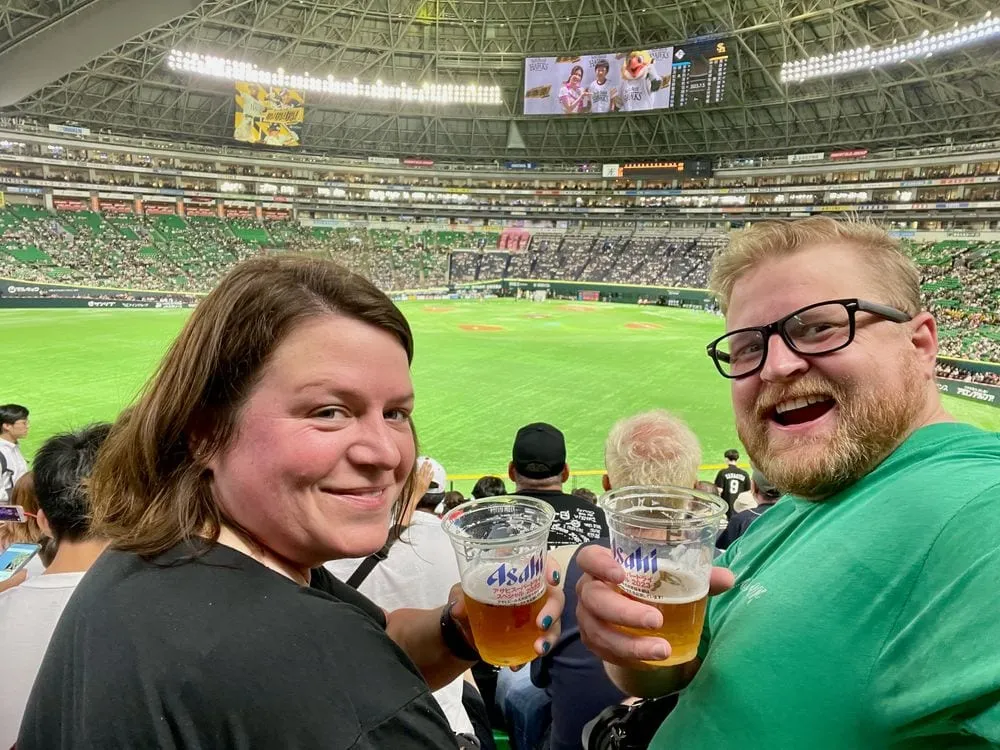
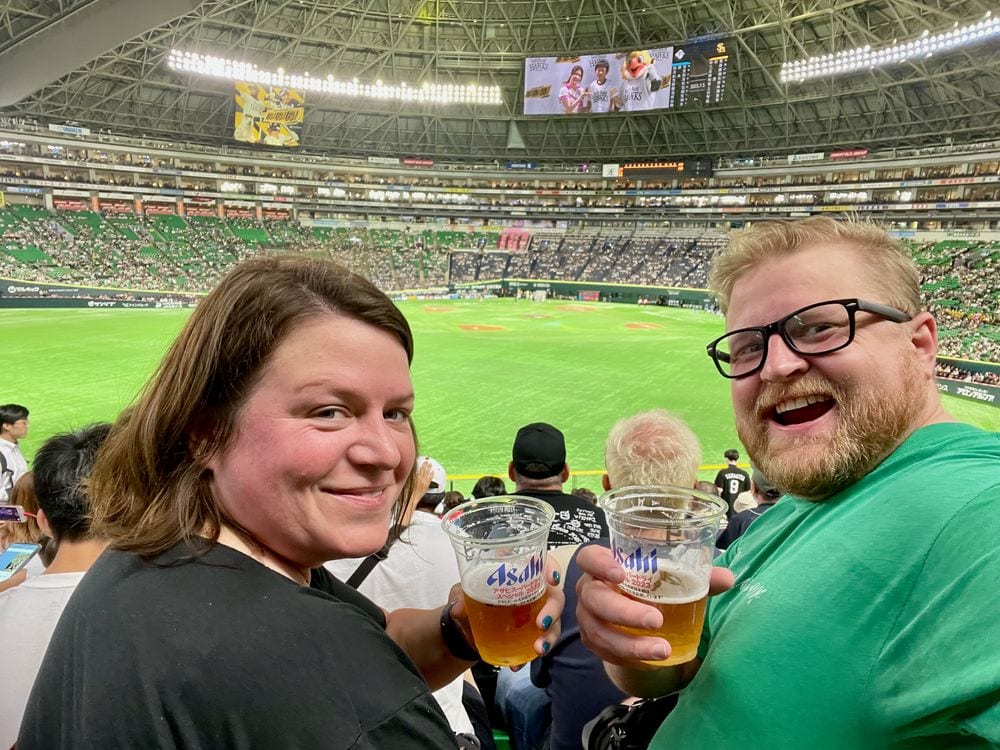
The real story behind this photo, pulled from our own trip footage from that week, wasn’t smooth. We’d landed in Fukuoka to rainy day after rainy day, ended up evacuating a hotel at one point, and spent the better part of a week trying to work out when and how to get into a Hawks game, aiming first for a July 4th date that didn’t come together. We finally made it in on July 5th instead, beers in hand by the time this photo was taken. None of that friction shows up in a straightforward “here’s what the ticket costs” post, but it’s worth knowing that a first-time visit to any stadium in a city you don’t know well can eat more planning time than the game itself.
PayPay Dome: the stadium itself
PayPay Dome, officially Mizuho PayPay Dome Fukuoka as of its current sponsor naming, opened in 1993 as the Fukuoka Dome, Japan’s first stadium built with a retractable roof and the only one in the country with that feature until Es Con Field Hokkaido opened in 2023. It cost a reported 76 billion yen to build and seats somewhere in the 38,000 to 40,000 range depending on configuration, sources vary on the exact number. The Hawks themselves moved to Fukuoka from Osaka under Daiei ownership, played four seasons at a different stadium first, then settled into the dome once it opened; SoftBank bought the team from Daiei in 2005, which is where the current name comes from.
Tokyo Dome: the one we’ve already covered
Tokyo Dome is older, opened in 1988, and home to the Yomiuri Giants, Japan’s most storied franchise rather than a regional club. We’ve already broken down its full seat-tier pricing in an earlier post, standing room from 1,500 yen up through premium seats well past 10,000 yen, so we won’t repeat the whole table here. The short version: Tokyo Dome’s pricing spread is wide and well documented, Reserved C seats sit in the affordable 2,200 to 2,800 yen range depending on the date, which is the tier most visiting families land in.
The team itself isn’t a minor detail
Part of why we’d pick a Hawks game again specifically: this isn’t some regional also-ran. The Hawks hold 12 Japan Series titles as of their 2025 championship, third-most in NPB history, built on two early titles as the Nankai Hawks in Osaka back in 1959 and 1964, a long drought, then a modern run that includes four consecutive championships from 2017 through 2020. A Giants game at Tokyo Dome puts you in front of Japan’s most famous franchise; a Hawks game at PayPay Dome puts you in front of one of its most consistently dominant ones, which is a real argument for the trip on its own, independent of the stadium’s engineering.
Getting to PayPay Dome
The Fukuoka City Subway’s Airport Line, also called the Kuko Line, runs to Tojinmachi Station, the recommended stop for the dome; from Exit 3 it’s roughly a 10 to 12 minute walk. On game days, direct shuttle buses also run from Hakata Station, the Tenjin Express Bus Terminal, and Fukuoka Airport, worth checking ahead of time since routes and schedules shift around specific events. Driving isn’t recommended on game days either, the roads around the dome and its own parking lot both get heavily congested, public transit is the more reliable option regardless of how the rest of your Fukuoka trip is laid out.
Ticket prices, side by side
| PayPay Dome (Hawks) | Tokyo Dome (Giants) | |
|---|---|---|
| Opened | 1993 | 1988 |
| Roof | Retractable, Japan’s first | Fixed dome |
| Capacity | roughly 38,000-40,000 | roughly 55,000 |
| Entry-level ticket | around 4,500-6,900 yen (2026 reseller pricing) | 1,500-2,800 yen (standing to Reserved C) |
| Premium ticket | can run into five figures | 6,800-7,700 yen (Reserved S) and up |
Tokyo Dome’s cheap seats undercut PayPay Dome’s by a wide margin, at least going by the pricing each reseller currently lists; a Hawks game at the entry tier can cost more than a comparable Giants seat. Neither number is something we paid ourselves that night, we don’t have an itemized receipt from 2023, so treat both columns as current reference pricing rather than what we personally spent.
Why we’d still pick a Hawks game again
Price alone doesn’t settle this one. PayPay Dome’s retractable roof is a genuine piece of stadium engineering history, not just a marketing line, and watching a game under it carries a different weight once you know it was the only one of its kind in Japan for three decades. It’s also a Kyushu-regional experience rather than a Tokyo one, a real reason to catch a game there specifically if your trip already has you in Fukuoka rather than treating baseball as something to check off only in the capital. Tokyo Dome wins on raw affordability and on convenience, it’s the stadium most visitors will pass near regardless of their itinerary, but PayPay Dome earns its own trip for the stadium itself, not just the box score.
Fukuoka SoftBank Hawks tickets
These are affiliate links. We may earn a commission if you book through them, at no extra cost to you. See our legal notice.
Klook code: ADAMANDLINDSKLOOK
Click through to Klook below, then enter code ADAMANDLINDSKLOOK at checkout. This is a real affiliate code, we may earn a commission on the booking too, at no extra cost to you. See our legal notice.
10% off, New Klook user
$50 minimum spend, capped at $50 off, one time use. Valid through December 31, 2026.
3% off, Existing Klook user
$50 minimum spend, capped at $50 off, up to three uses. Valid through December 31, 2026.
1% off, Selected things to do and mobility, including teamLab Planets TOKYO, teamLab Borderless, teamLab Biovortex Kyoto, Japan Shinkansen tickets, SHIBUYA SKY, Warner Bros. Studio Tour Tokyo, and Osaka Amazing Pass
No stated minimum spend for this tier. Valid through December 31, 2026.
50% off, eSIM, new eSIM customers only
No minimum spend, capped at $1.50 saved, one time use. Valid through December 31, 2026.
That Klook listing is built specifically for international visitors, a voucher exchanged for a physical ticket at a dedicated counter by Gate 5 rather than a general-admission walk-up, worth knowing ahead of a game day since Japanese residents aren’t eligible to book through it.
Was it worth it
Completely, and mostly because it wasn’t the version of the trip we’d planned. A week of rain, a hotel evacuation, and a missed July 4th target turned into a Hawks game two days later instead, and the photo from that night is one of the only real souvenirs from an otherwise rough stretch of the Fukuoka leg. If Tokyo Dome is the baseball stop most visitors will default to, PayPay Dome is the one worth actively choosing, a different stadium with its own real history, not a lesser substitute for the one everyone already writes about.