Japan's Clear Umbrella: What It Costs and Why Everyone Has the Same One
A rainy Osaka night walk under a clear vinyl umbrella, the kind sold everywhere in Japan. Real history, real convenience store prices, and real lost-and-found numbers.

Published on 4 min read
On this page
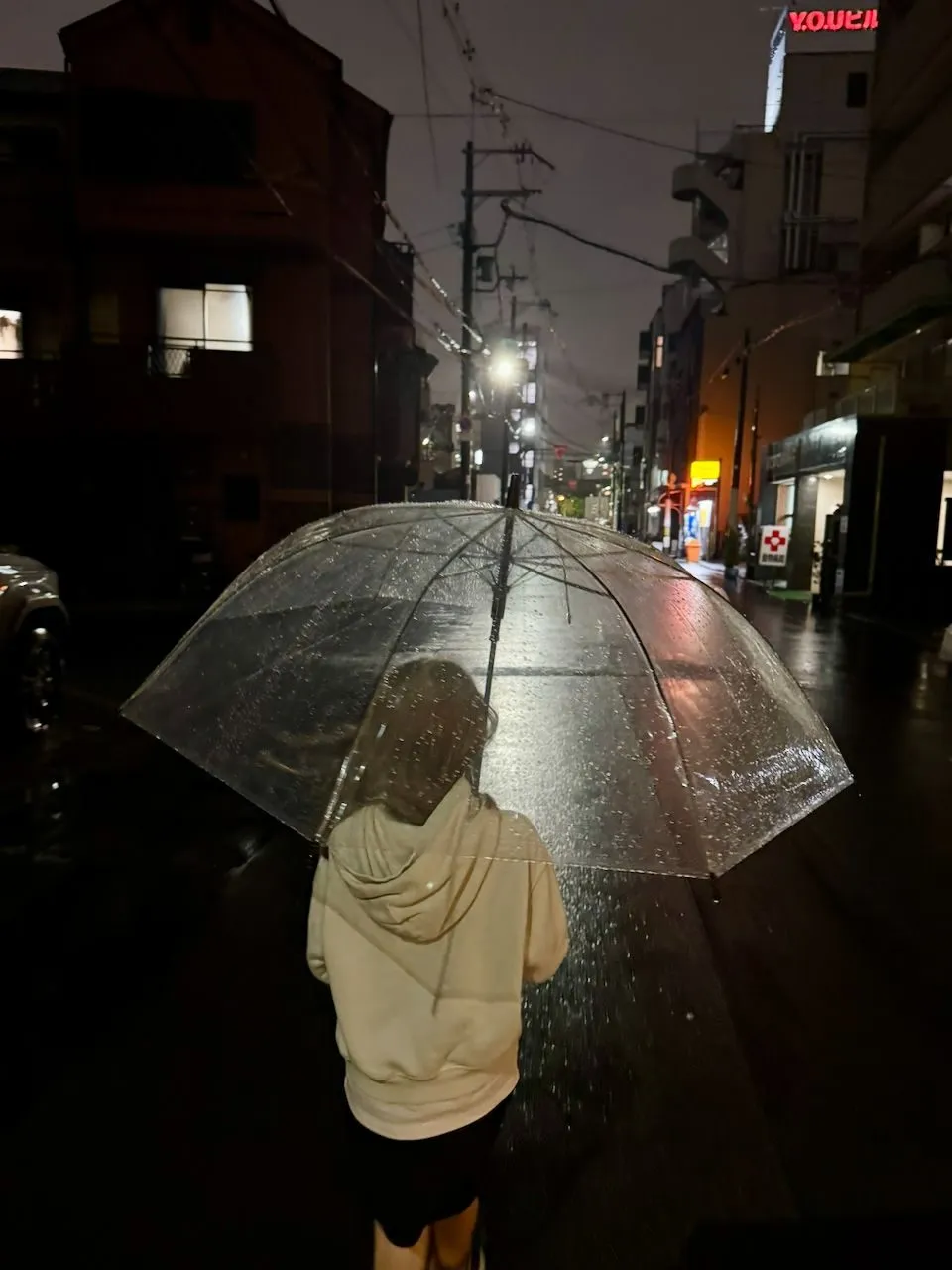
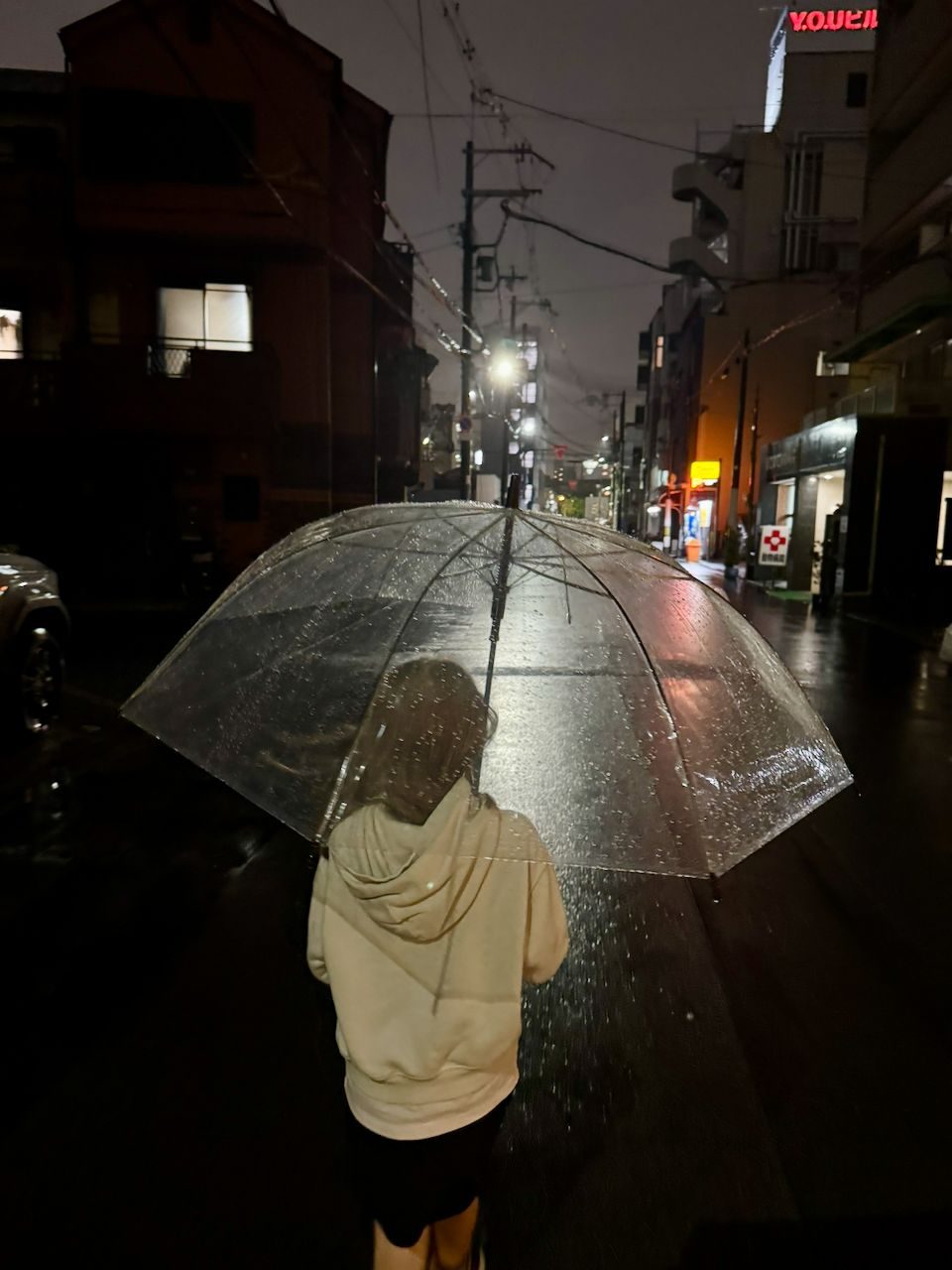
A rainy night in April 2026, a quiet side street near our Osaka apartment, a clear vinyl umbrella the only real plan either of us had made for the weather. It’s the same umbrella sold in nearly every convenience store in Japan, the kind that shows up in photos of Tokyo rain so often it’s become its own visual shorthand for the country.
What came before it
Before plastic, the wagasa, a foldable oiled-paper umbrella, was Japan’s everyday rain cover, spreading to ordinary commoners early in the Edo period after craftsmen reworked older silk status umbrellas into a lighter, practical, foldable form. A single wagasa took months to produce by hand but, dried properly after each use, could last up to a decade. Gifu became one of the industry’s real production centers, shipping an estimated 520,000 umbrellas north to Edo in a single year near the period’s end. The decline came fast once Western-style umbrellas arrived during the Meiji era, cheaper and faster to make, and wagasa production shrank to a small handful of regions, Gifu, Kyoto, Tottori, and Toyama among the few still producing them today as a craft rather than an everyday purchase.
Where it came from
Sources disagree on the exact origin story, and we’re not picking a winner. One account credits White Rose, a manufacturer based in Tokyo’s Asakusa district, with producing the world’s first plastic umbrella in 1958. A separate account describes a more accidental start, an umbrella maker named Mitsuo Sudou experimenting with plastic covers for ordinary cotton umbrellas sometime in the same decade, an idea that gradually became the clear umbrella itself rather than a cover for something else. Both versions land in the same 1950s window, neither is firmly documented enough to call settled fact. What is better documented: the 1964 Tokyo Olympics put Japan’s clear umbrellas in front of a global audience for the first time, part of why the image stuck internationally the way it did.
What it costs
A clear umbrella at a Japanese convenience store runs roughly 300 to 1,000 yen depending on size and build quality, with the cheapest versions showing up at 100 yen shops. Price isn’t really the interesting number here though, loss rate is.
How fast a konbini reacts to rain
Convenience stores are a real, immediate part of this system too. The moment rain starts, staff move umbrella stock from wherever it’s normally kept to a display right at the entrance, the kind of fast restocking that only makes sense for a product people buy in the exact five minutes they realize they need one, not before and rarely after. It’s less a seasonal display than a live response to the weather outside the door.
The real lost-and-found numbers
Japan’s clear umbrella culture comes with a real, strange side effect: because almost everyone carries the identical plastic dome, almost no one gets their own umbrella back once it’s set down somewhere. The Tokyo Metropolitan Police lost-and-found center took in roughly 300,000 umbrellas in one recent year. Only 3,700 were ever reunited with an owner, a return rate of about 1 percent. Nagoya Railroad’s own FY2025 numbers tell a similar story on a smaller scale: about 10,000 traditional stick umbrellas and 7,000 clear ones collected as lost property, with only around 10 percent of the clear umbrellas ever claimed. When every umbrella in a train car looks exactly the same, “that’s mine” stops being a claim anyone can prove, and millions of yen worth of plastic domes quietly become, in practice, public property.
What happens if you’re caught without one
Convenience stores aren’t the only real option for a sudden downpour. Umbrella vending and rental machines exist at some train stations, less common than drink machines but real: a straightforward purchase machine running around 500 yen, or in Tokyo, a station-based umbrella-sharing service charging roughly 140 yen per 24 hours, with an unlimited monthly plan around 280 yen for anyone commuting through rainy season regularly. Return the shared umbrella at any station in the network rather than the one you picked it up from, built specifically around the reality that nobody’s walking back to the exact station where they grabbed one.
Was it worth carrying one
Completely, and for under 1,000 yen it would have been even if we’d needed to buy it on the spot rather than already owning one. A clear umbrella on a quiet rainy street turned out to be worth more as a photo than as actual rain protection that night, but the real numbers behind it, a nearly seven-decade-old design nobody fully agrees on the origin of, hundreds of thousands lost every year, barely any of them ever reclaimed, make it one of those completely ordinary objects that turns out to have a real story once you look past the convenience store shelf it’s sitting on.