JR Haruka or Nankai Rapi:t: Getting to Kansai Airport for the Least Yen
Two real train options get you from Osaka to Kansai Airport. Real current fares for both, plus the cheap backup option neither guide mentions first.

Published on 6 min read
On this page
Two real limited express trains connect Osaka to Kansai Airport, and they don’t serve the same side of the city. JR’s Haruka runs from Shin-Osaka, Osaka Station, and Tennoji. Nankai’s Rapi:t runs from Namba. Picking the wrong one for where you’re staying costs more than picking the cheaper option, so here’s what each one runs.

The airport itself is a real engineering story
Kansai Airport didn’t exist until 1994. It opened September 4 of that year, built to take pressure off the old Osaka Itami Airport, on an artificial island constructed in Osaka Bay starting in 1987, Terminal 1 designed by Renzo Piano. It’s since grown to two connected artificial islands covering over 1,000 hectares combined. The island has a well known, real problem: it’s sinking. Built on soft bay clay, it settled faster than engineers first predicted, reported figures put the total subsidence at around 38 feet since opening, though exact numbers vary by source and by which part of the island is measured. The sink rate has slowed from roughly 50 centimeters a year right after opening to around 7 centimeters a year by 2008, after a seawall project costing upward of $150 million and terminal columns engineers can still physically jack up in stages as the ground beneath them keeps settling. None of that affects a train ticket, but it’s worth knowing the ground under the whole comparison below is, quite literally, still moving.
Why we were there
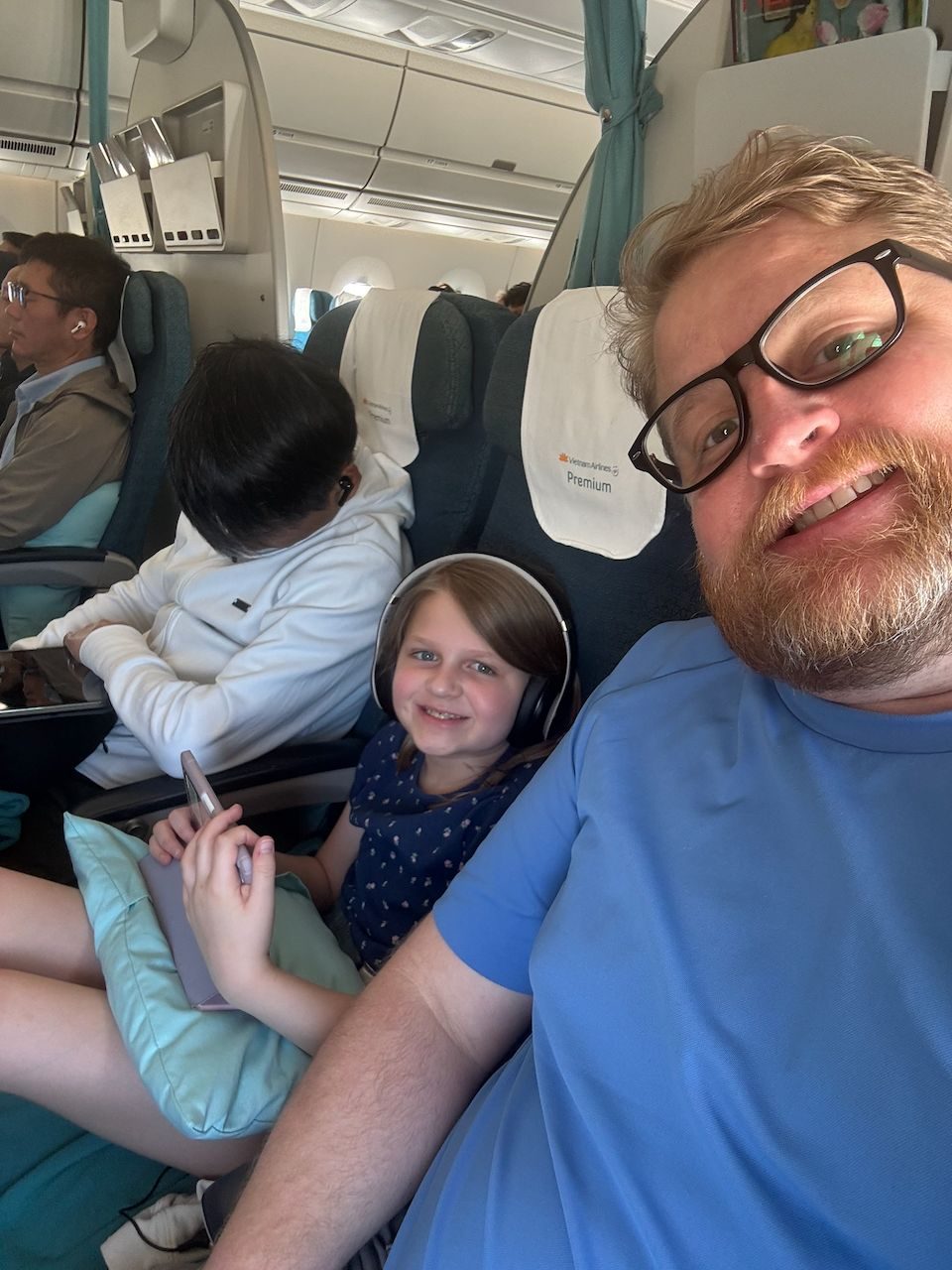
This photo is from May 5, 2026, the morning we flew out of Kansai Airport on Vietnam Airlines, a premium cabin seat for the international leg to Ho Chi Minh City and on to Da Nang. We’d been staying in Osaka. We don’t have a receipt or a photo of whichever train got us to the airport that morning, so we’re not claiming it was one option over the other here, what follows is real current pricing for both of the main options, for anyone facing the same choice.
Nankai Rapi:t, from Namba
The Rapi:t is the choice if you’re staying anywhere near Namba or southern Osaka. It’s a reserved-seat limited express, 35 to 40 minutes to Kansai Airport Station, no changes. A Regular Seat runs 1,490 yen (a 970 yen base fare plus a 520 yen limited express surcharge), Super Seat runs 1,700 yen (970 plus 730), current as of an April 2026 fare revision. A separate discount ticket exists too, the Kansai Airport Discount Rapi:t Ticket, though sources disagree on its exact price, somewhere around 1,350 to 1,560 yen depending on where we checked, worth confirming at a Nankai ticket counter rather than trusting one figure. Every seat on every Rapi:t service is reserved, so there’s no standing-room fallback if a train’s sold out.
JR Haruka, from Shin-Osaka, Osaka Station, or Kyoto
Haruka is the one to take if you’re closer to Shin-Osaka, central Osaka Station, or coming from Kyoto. Pricing here is harder to pin down than Rapi:t’s, our sources ranged from around 1,830 yen up past 3,000 yen for the same Shin-Osaka route depending on seat type, ticket type, and when each guide was written, wide enough that we’re not quoting one number as the answer. Two things are solid regardless of that spread: it’s free for anyone riding on a Japan Rail Pass, and foreign tourists on a short-term visa can buy the discounted Haruka ticket at 1,800 yen to Shin-Osaka with a passport, a real, specific exception to the regular fare. A separate bundle, ICOCA&HARUKA, packages a prepaid ICOCA card with a one-way Haruka ticket to Kyoto for 3,000 yen total, sold as a deal against buying the card and the ticket separately.
The cheap option neither train company leads with
Nankai also runs a regular Airport Express on the same Namba line as the Rapi:t, no reservation, no limited express surcharge, just the base fare: 970 yen one way, 45 to 50 minutes, about 10 minutes slower than the Rapi:t for roughly a third of the Super Seat price. It’s the one worth knowing about if the Rapi:t schedule doesn’t line up or the reserved seats are sold out, same train line, same station, a cheaper way to the same place.
The bus option, if a train transfer isn’t worth it
A limousine bus runs directly between Kansai Airport and stops across Osaka and the wider Kansai area, Osaka Station, Namba, Kobe Sannomiya among them, no transfer required if your hotel sits near a stop. Fares here were the least consistent of everything we checked, guides ranged from 1,000 yen up to 1,880 yen for broadly the same routes depending on the source and the date it was written, so treat any single figure skeptically. What is confirmed: a real, bookable Klook listing exists for this exact bus (4.8 stars, 7,700+ reviews), redeemed by QR code straight from the Klook app, no paper ticket required.
Kansai Airport Limousine Bus to Osaka
These are affiliate links. We may earn a commission if you book through them, at no extra cost to you. See our legal notice.
Klook code: ADAMANDLINDSKLOOK
Click through to Klook below, then enter code ADAMANDLINDSKLOOK at checkout. This is a real affiliate code, we may earn a commission on the booking too, at no extra cost to you. See our legal notice.
10% off, New Klook user
$50 minimum spend, capped at $50 off, one time use. Valid through December 31, 2026.
3% off, Existing Klook user
$50 minimum spend, capped at $50 off, up to three uses. Valid through December 31, 2026.
1% off, Selected things to do and mobility, including teamLab Planets TOKYO, teamLab Borderless, teamLab Biovortex Kyoto, Japan Shinkansen tickets, SHIBUYA SKY, Warner Bros. Studio Tour Tokyo, and Osaka Amazing Pass
No stated minimum spend for this tier. Valid through December 31, 2026.
50% off, eSIM, new eSIM customers only
No minimum spend, capped at $1.50 saved, one time use. Valid through December 31, 2026.
The real cost built into the ticket already
One more real number applies to every option above once you’re leaving the country, not just reaching the airport: Japan’s International Tourist Tax, 1,000 yen per person, collected by the airline and folded into the ticket price rather than charged separately at a counter. It’s taken since January 2019 from almost everyone departing by air or sea, residents included, not a tourist-only fee, with the one practical exception being children under two and anyone transiting through within 24 hours. For a family of five, that’s 5,000 yen already built into five airfares before a single train ticket to the airport gets bought, worth knowing it’s there rather than mistaking a slightly higher fare for an airline markup.
What a family pays, side by side
One adult ticket is one number. A family of five paying four of these options at once looks different:
| Option | One adult, one way | Family of 5 (3 kids at child fare where offered) |
|---|---|---|
| Nankai Airport Express | 970 yen | Roughly 3,400-3,900 yen (child fare around 490 yen) |
| Nankai Rapi:t, Regular Seat | 1,490 yen | Roughly 5,900-6,700 yen, reserved seats for everyone |
| JR Haruka, standard fare | 1,830-3,060 yen (range, see above) | Could run anywhere from about 7,000 to over 12,000 yen at that spread |
| Limousine bus | 1,000-1,880 yen (range, see above) | Roughly 3,500-7,500 yen, no per-child discount confirmed |
The spread on Haruka and the bus is wide enough that it’s worth checking the current fare before assuming either number, but the Airport Express’s 970 yen floor stays the cheapest way to the airport from Namba by a wide margin no matter which other figure turns out to be current.
Which one’s worth it
If you’re near Namba, the Rapi:t or its cheaper Airport Express sibling wins on convenience, same station, same line, pick the reserved comfort or the lower price. If you’re near Shin-Osaka or coming from Kyoto, Haruka is the only direct option worth comparing against a taxi, and the foreign-visitor discount ticket or the ICOCA&HARUKA bundle are worth checking before paying the standard fare. If you’re hauling bags and kids and don’t want a station transfer at all, the bus trades a bit of speed for a single seat from curb to curb. None of these is a bad choice, they just answer different questions, where you’re starting from, and how much a reserved seat and a direct ride are worth to you that morning.