A Giant Mario Welcomed Us Back to Japan at Narita Airport
A Mario-themed welcome display at Narita, a paid airport lounge, and the real, violent history behind why Narita exists at all. Real transit pricing to get into Tokyo from there.

Published on 5 min read
On this page
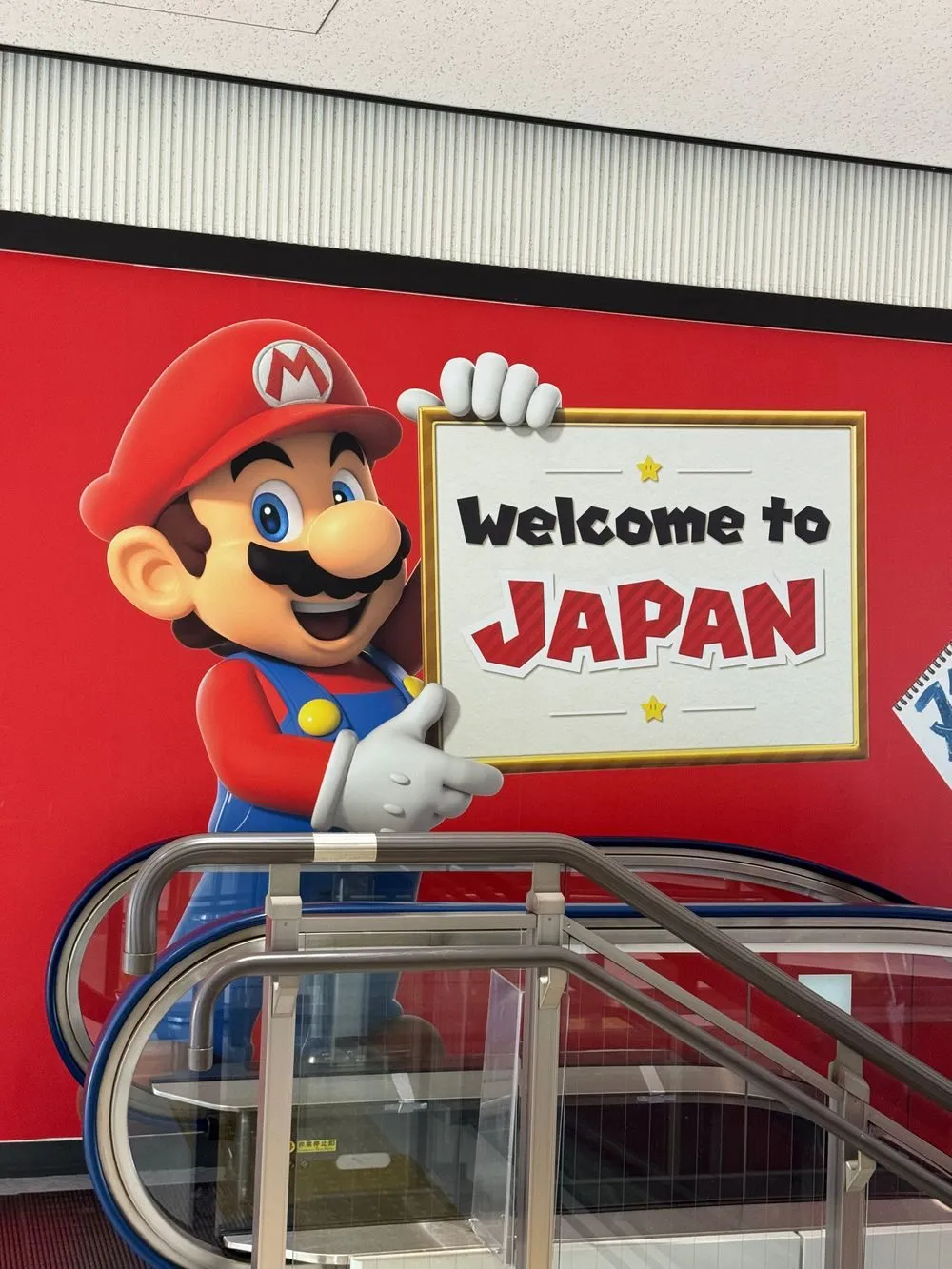
Coming down an escalator at Narita Airport in May 2024, a giant Mario was standing there holding a sign that read “Welcome to Japan.” Neither of us had seen anything like it on an earlier trip through the same terminal, and we didn’t plan around it, it was just there, part of the walk from the gate toward immigration.
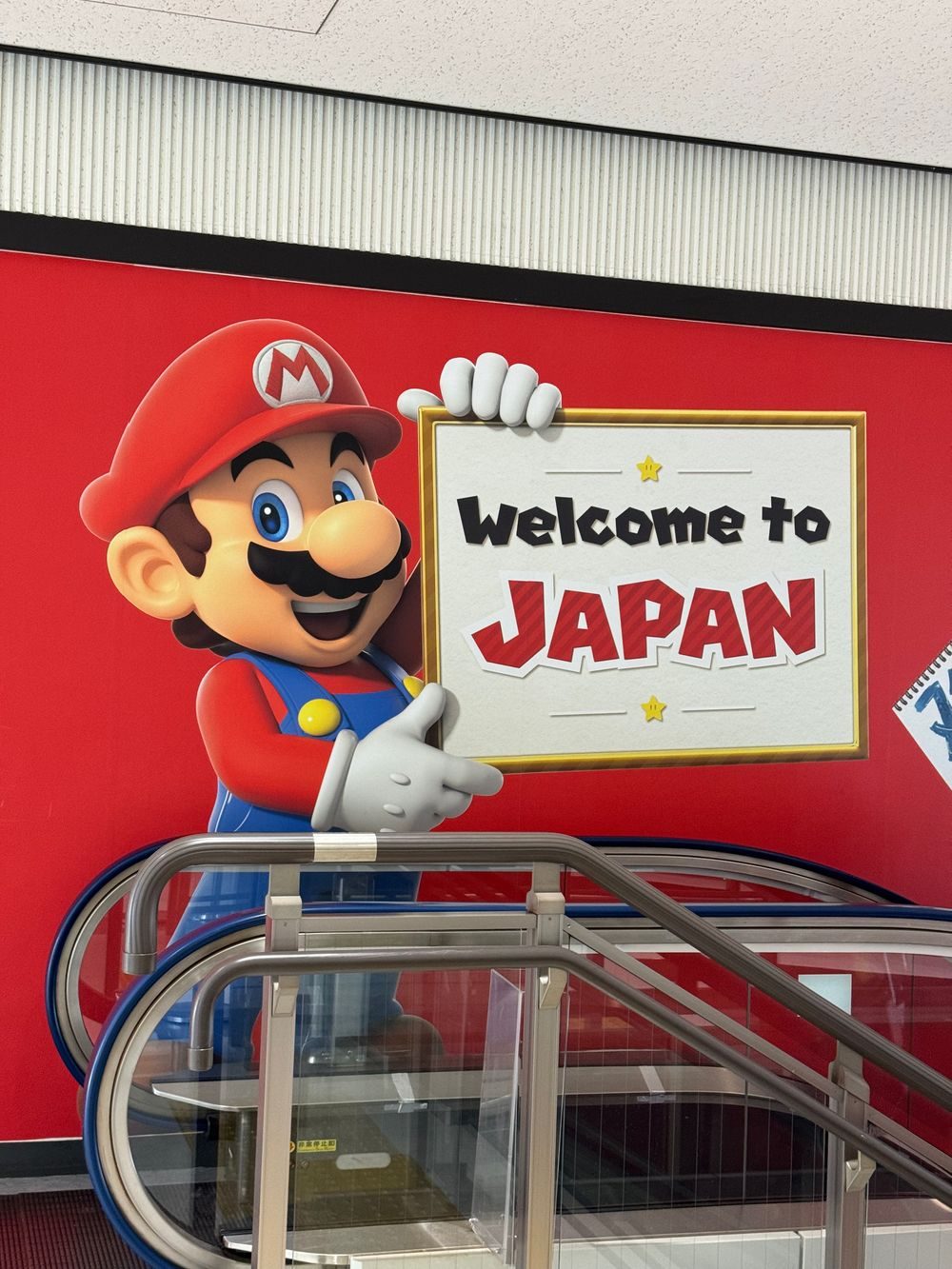
We can’t confirm this was permanent
The honest version of this story: Narita ran a real, confirmed Nintendo promotion in its Terminal 1 Visitor Service Center in June 2022, a temporary “Nintendo Check In” open for two days, with an escalator shaft decorated in Mario characters for arriving international passengers. Our own photo is from May 2024, nearly two years later, which means either the display came back for a second run, became a longer-running fixture than the original two-day event, or we’re simply looking at a different, undocumented installation entirely. We don’t have a source confirming which. Said so plainly rather than claiming certainty about something we can’t verify.
The other side of the terminal: a paid lounge
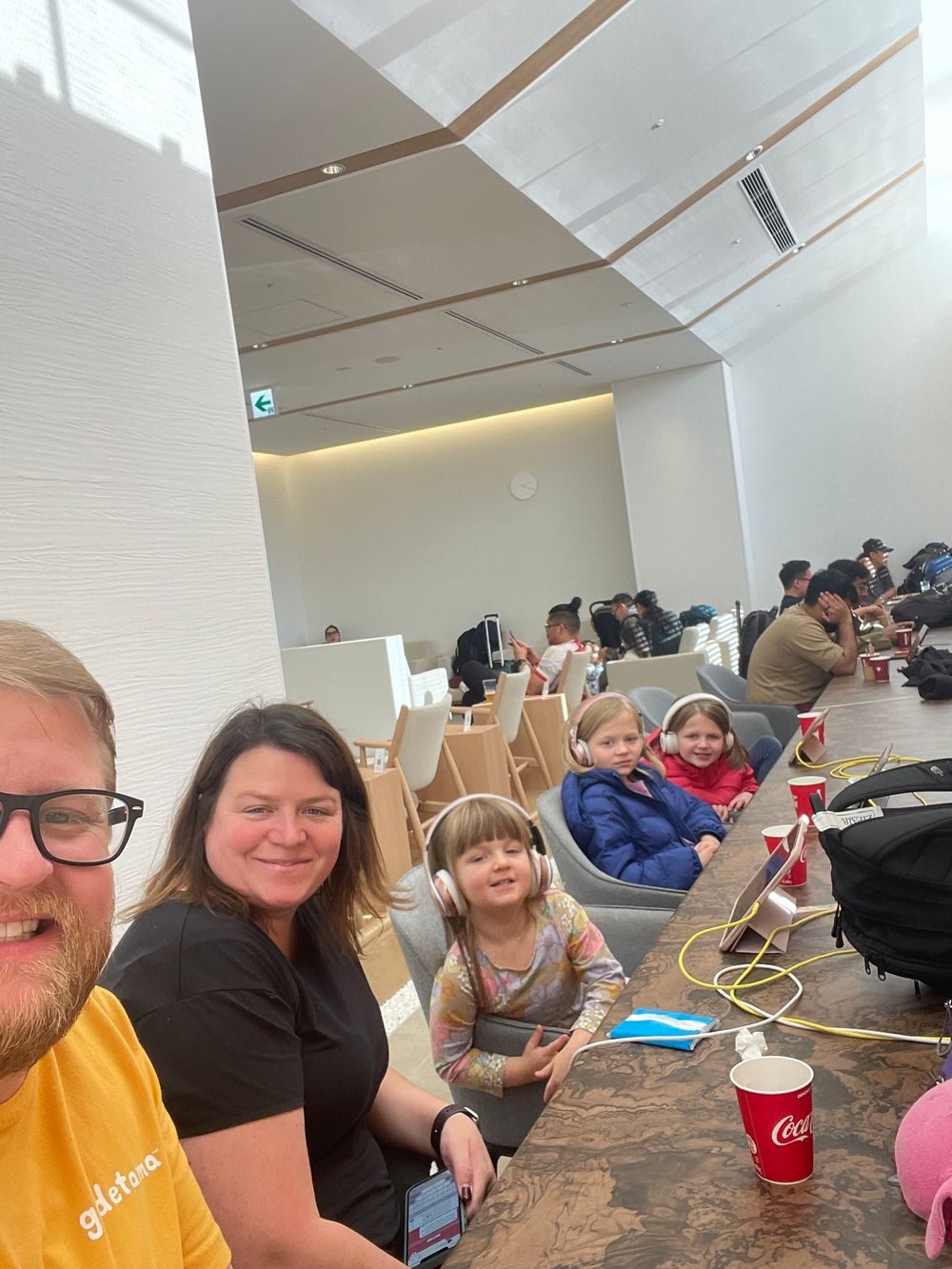
A separate December 2023 visit, a different kind of airport spending entirely: a stop in a paid lounge rather than a generic gate area. We don’t know exactly which lounge this was or what we paid, but real current pricing at Narita gives a sense of the range. ANA’s paid lounge access runs 8,800 yen booked online in advance, climbing to 13,200 yen paid at the counter the same day, for flights on ANA-operated routes only. A ZIPAIR-linked lounge in Terminal 1 charges a flat 9,200 yen. An older, since-likely-changed listing for a shared lounge near Gate 26 put the price as low as 1,600 yen, a reminder that “a paid lounge at Narita” isn’t one fixed number, it depends heavily on which lounge and which airline’s deal applies.
Why Narita exists where it does
Narita’s location, well outside central Tokyo in Chiba Prefecture, isn’t an accident of convenience, it’s the result of one of postwar Japan’s longest and most violent land disputes. The government settled on the Sanrizuka site in the 1960s, land tied to the Imperial Household, and local farmers organized against the project starting in 1966 under what became known as the Sanrizuka-Shibayama opposition league. The conflict turned deadly: three policemen were killed during a 1971 land expropriation, and opposition drew real support from student and left-wing movements of the era. The airport was scheduled to open March 30, 1978, but on March 26, protestors broke into the nearly-finished control tower and destroyed much of its equipment, an estimated $500,000 in damage, delaying the opening by roughly two months to May 20, 1978. The dispute didn’t end there either, formal talks between opposition groups and the government ran through the early 1990s, and some opposition to further runway expansion continues today. None of that history is visible walking through the terminal, but it’s the real reason Narita sits where it does rather than closer to the city.
The dispute never fully ended
One real, still-unresolved detail makes the history feel less like a closed chapter: Takao Shito, a farmer, held onto a small landholding, roughly 4,600 square meters near runway B on the airport’s north side, refusing to sell as the second runway was planned through his family’s farmland. Rather than remove him, the airport altered the runway’s own route to curve around his lot, most of it reachable only through tunnels under the airport grounds, with a fence erected around the holdout plot itself. A court ordered his eviction in September 2022, and skirmishes broke out in February 2023 as authorities moved to clear structures from the site. Shito has said publicly he has no intention of leaving. We can’t confirm his current status walking through the terminal today, these reports run through early 2023 and we found nothing more recent, but the detail that a working airport runway still bends around one farmer’s land says more about how unresolved this history still is than any plaque or museum display could.
What it costs to leave the airport
Two real options get you from Narita into central Tokyo, and they go to different places. The Keisei Skyliner runs to Ueno in about 41 minutes for roughly 2,500 to 2,600 yen one way, cheaper booked online than at the counter. The JR Narita Express (N’EX) runs to Tokyo Station in about 60 minutes for roughly 3,000 to 3,250 yen, a reserved-seat train that also stops at Shinjuku. The two aren’t interchangeable for trip planning: the Skyliner never reaches Tokyo Station at all, and a Japan Rail Pass covers the N’EX but not the privately-run Skyliner.
A real cheaper option exists too if the premium trains aren’t worth it for a given trip: the Airport Bus TYO-NRT runs to Tokyo Station for about 1,500 yen during the day, rising to around 3,000 yen for late-night and early-morning departures, and the slowest, cheapest route of all combines the regular Keisei Main Line to Nippori (roughly 1,060 yen) with a short JR transfer (about 200 yen more) into Tokyo Station, well under half the Skyliner’s fare for a family willing to trade speed for savings.
Keisei Skyliner, Narita Airport to Ueno
These are affiliate links. We may earn a commission if you book through them, at no extra cost to you. See our legal notice.
Klook code: ADAMANDLINDSKLOOK
Click through to Klook below, then enter code ADAMANDLINDSKLOOK at checkout. This is a real affiliate code, we may earn a commission on the booking too, at no extra cost to you. See our legal notice.
10% off, New Klook user
$50 minimum spend, capped at $50 off, one time use. Valid through December 31, 2026.
3% off, Existing Klook user
$50 minimum spend, capped at $50 off, up to three uses. Valid through December 31, 2026.
1% off, Selected things to do and mobility, including teamLab Planets TOKYO, teamLab Borderless, teamLab Biovortex Kyoto, Japan Shinkansen tickets, SHIBUYA SKY, Warner Bros. Studio Tour Tokyo, and Osaka Amazing Pass
No stated minimum spend for this tier. Valid through December 31, 2026.
50% off, eSIM, new eSIM customers only
No minimum spend, capped at $1.50 saved, one time use. Valid through December 31, 2026.
Was it worth the stop
Both stops, completely, in their own way. A free, slightly surreal Mario welcome on one trip and a quiet paid lounge on another turned two otherwise forgettable transit days into something worth remembering, and neither required planning ahead the way a theme park or a museum ticket does. Narita itself, the ground it sits on and the real fight it took to open it, turned out to be worth knowing about too, the kind of history a family walks straight past at baggage claim without ever learning it happened.