What's Free Inside Nihon Minkaen, and What Costs Extra
Nihon Minkaen's 550 yen admission covers 25 relocated Edo period buildings and hands-on games. Indigo dyeing and the on-site soba restaurant cost extra, here's the real split.

Published on 5 min read
On this page
We covered Nihon Minkaen’s admission price when we first wrote about it, 550 yen for an adult, free for middle school age and under. What we didn’t break down is what that 550 yen buys once you’re inside versus what costs more on top of it, because this open-air folk museum in Kawasaki has both: a surprising amount of free, hands-on activity included in the ticket, and a couple of real extras that aren’t.
What’s included once you’re inside
Admission gets you into all 25 relocated Edo period buildings, farmhouses, a kabuki stage, samurai residences, walked through at your own pace with no extra fee per building. What we hadn’t mentioned before is how much of the grounds is set up for hands-on play rather than look-but-don’t-touch, all covered by that same ticket:
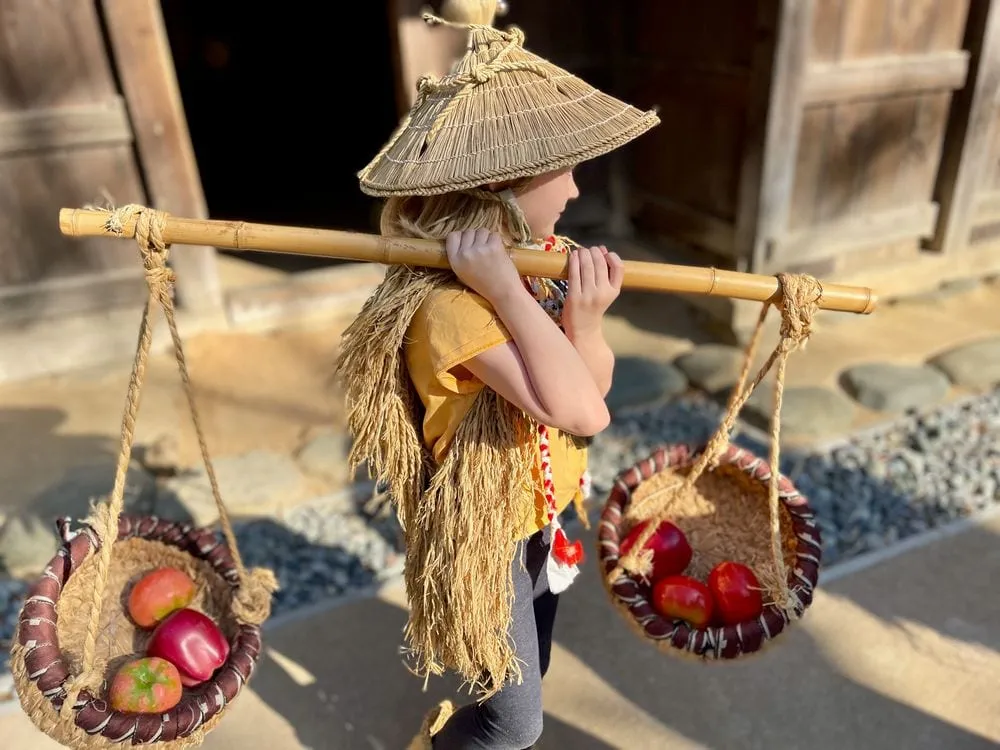
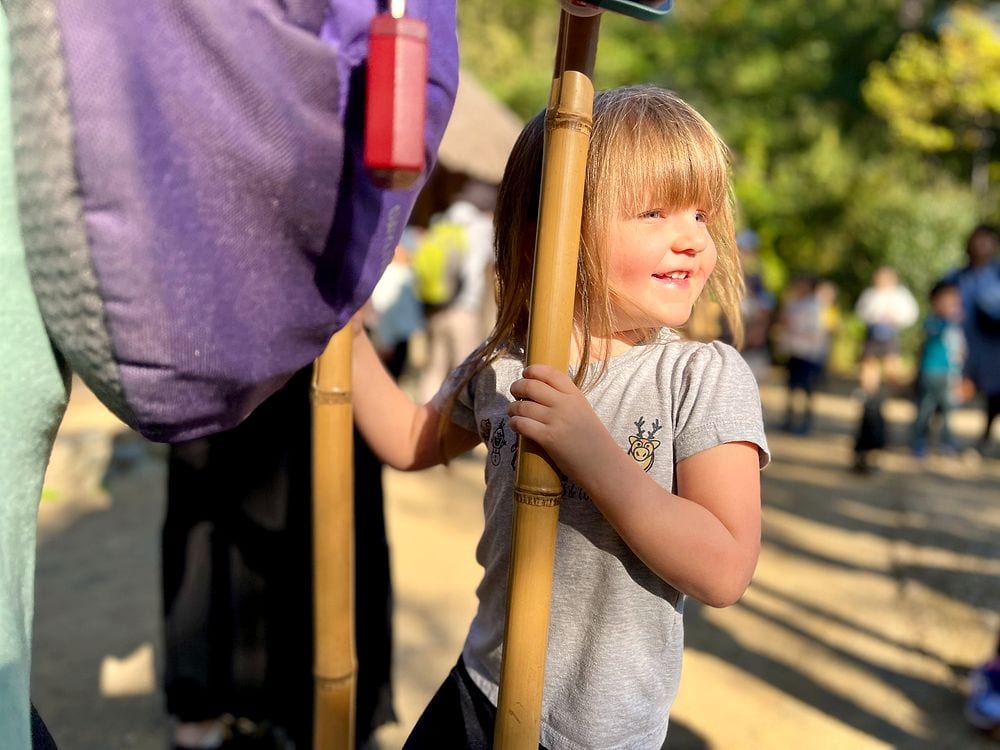
- A wooden yoke with hanging baskets, set out near one of the farmhouses, free for any kid to sling over their shoulders and try carrying the way farmers once hauled produce.
- Traditional ring toss (wanage), rings and a target set up in the open courtyard, no fee, no staff supervision required, just pick up a ring and throw.
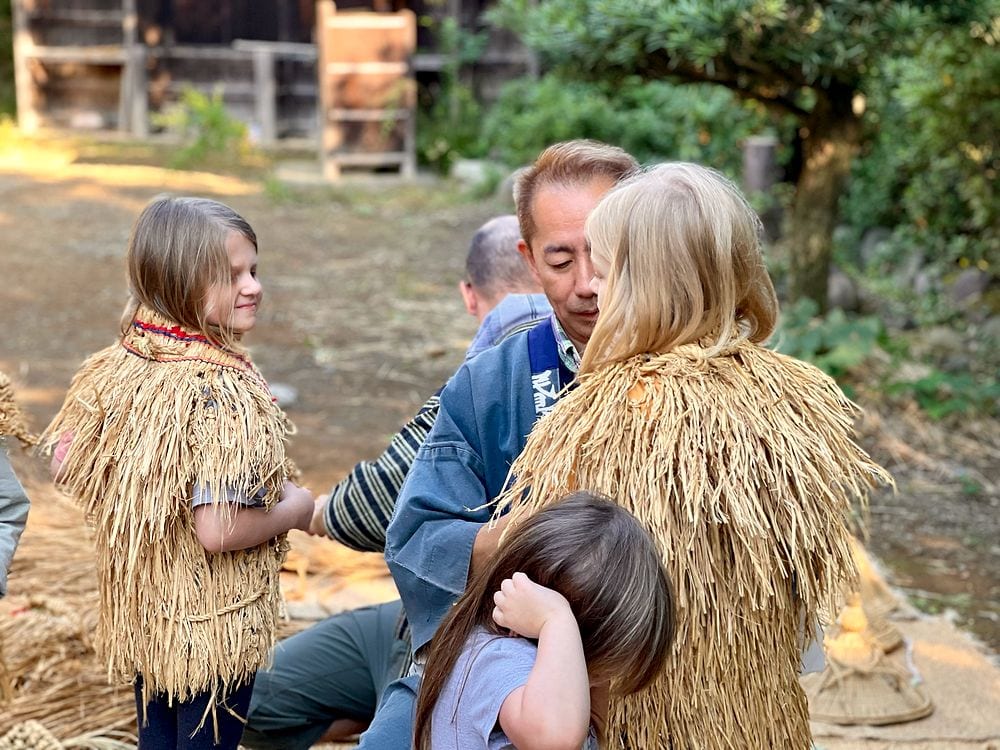
- Straw hats and capes, available to try on near the farmhouse entrances, the same gear farm laborers would have worn, free to put on for photos.
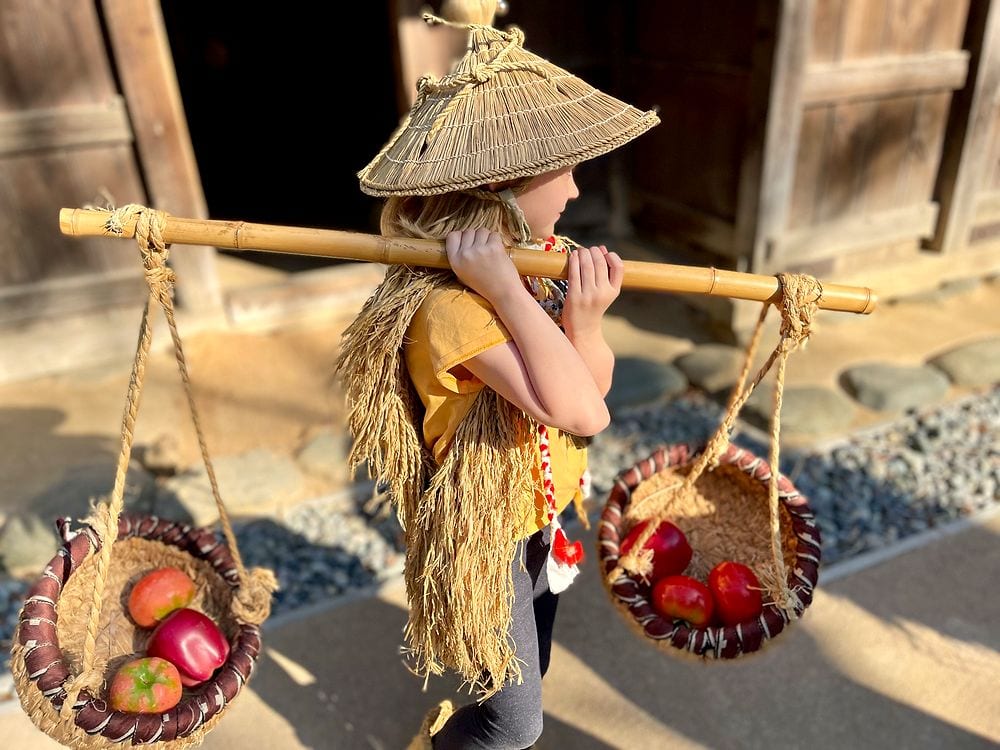
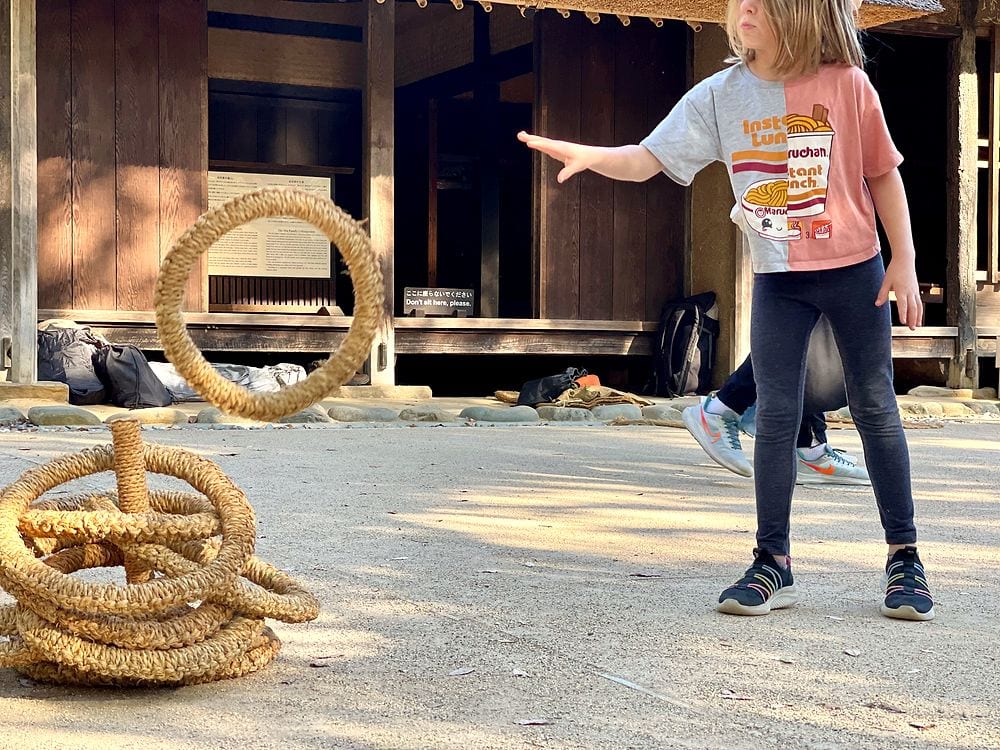
None of this is a scheduled show with a set start time, it’s just there on the grounds to use whenever you walk past it, which is part of why we had entire sections of the museum to ourselves on a quiet autumn weekday.
With three kids spanning a few different ages, the free side of the grounds ended up doing more work than we expected. The ring toss and the yoke don’t need an adult to run them or a reservation to hold a spot, so each girl could drift to whichever one held her attention longest while we weren’t managing a queue or a clock. Harper spent most of her time on the ring toss alone, Cora wanted the yoke redone twice once she felt how much the baskets weighed with something in them, and Lily was happiest just walking the grounds in the straw cape. None of that split attention would have worked as smoothly around a single paid, scheduled activity with one booking for all three.
What costs extra
Two things at Nihon Minkaen cost real money beyond the base ticket, and neither one requires that ticket at all.
Traditional indigo dyeing, run out of the Dento-Kogeikan workshop house near the west gate, charges by the item: a plain handkerchief runs 1,320 yen, a bandana 1,430 yen, a tenugui hand towel 1,870 yen, and a tote bag 3,850 yen, each dyed on site in one of the workshop’s eight indigo vats. Bringing your own fabric is cheaper on a per-item basis but adds a 660 yen half-day facility fee on top of a per-gram dyeing charge, so a pre-made item is simpler for a one-off family visit. Reservations are required, it isn’t a walk-up activity the way the ring toss is.
Sobadokoro Shirakawa-go, the restaurant built into the Yamashita House, a real Kanagawa Prefecture important cultural property, serves soba made fresh daily from Hokkaido buckwheat flour. A plain mori soba runs 600 yen, sansai soba with mountain vegetables 650 yen, tororo soba with grated yam 700 yen, and the restaurant’s own minkaen soba tops out at 800 yen. The detail that surprised us most researching this: the restaurant has its own entrance separate from the museum gate, so you can eat here without paying museum admission at all, a real option if you’re just passing through Ikuta Ryokuchi park and want a cheap, legitimate soba lunch rather than a museum visit.
Getting there
Nihon Minkaen sits inside Ikuta Ryokuchi park in Kawasaki, reachable two ways from central Tokyo: the Odakyu Odawara Line runs about 20 minutes from Shinjuku (270 yen) to Mukogaoka-Yuen Station, then a 15 minute walk, or the JR Nambu Line runs about 30 minutes from Kawasaki Station (350 yen) to Noborito Station, then a 25 minute walk. The museum opens at 9:30 and closes at 17:00 (16:30 from November through February), last admission 30 minutes before close, closed Mondays. Worth knowing if you’re weighing the soba restaurant’s separate entrance: Sobadokoro Shirakawa-go keeps its own hours, not identical to the museum’s, so check ahead if lunch there is the actual plan rather than a stop inside a longer museum visit.
The real split
| Included in 550 yen admission | Costs extra | |
|---|---|---|
| Walking the 25 buildings | Yes | — |
| Shoulder yoke, ring toss, straw costumes | Yes | — |
| Indigo dyeing (pre-made item) | — | 1,320 to 3,850 yen |
| Soba lunch | — | 600 to 800 yen, no museum ticket required |
For our family of five, two adult tickets at 550 yen was the entire required cost, 1,100 yen for the whole afternoon. We didn’t do the indigo dyeing or eat at the soba restaurant that day, the free hands-on activities alone filled the time, but knowing both extras exist, and that the soba restaurant doesn’t even require admission, changes how we’d plan a return trip.
Was it worth it
Completely, and this time for a different reason than the first post gave: it isn’t just that the admission is cheap, it’s how much of what makes a visit memorable here, the yoke, the ring toss, trying on a straw cape, costs nothing beyond that single ticket. The paid extras are real and worth knowing about if indigo dyeing or a sit-down soba lunch fits your day, but nobody needs either one to leave Nihon Minkaen having gotten their money’s worth.