Supermarket Drink Prices in Shibamata, Tokyo: Every Price Tag on One Shelf
What one cold-drink shelf at a neighborhood Tokyo supermarket charges, item by item, and how those prices compare to a vending machine or a convenience store.

Published on 5 min read
On this page
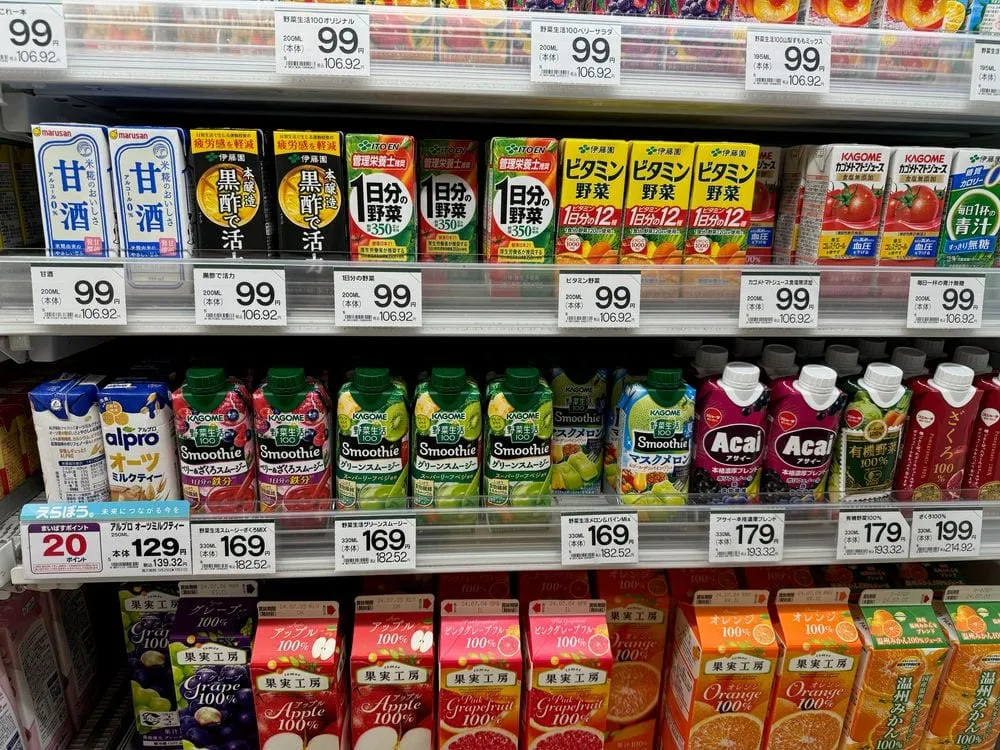
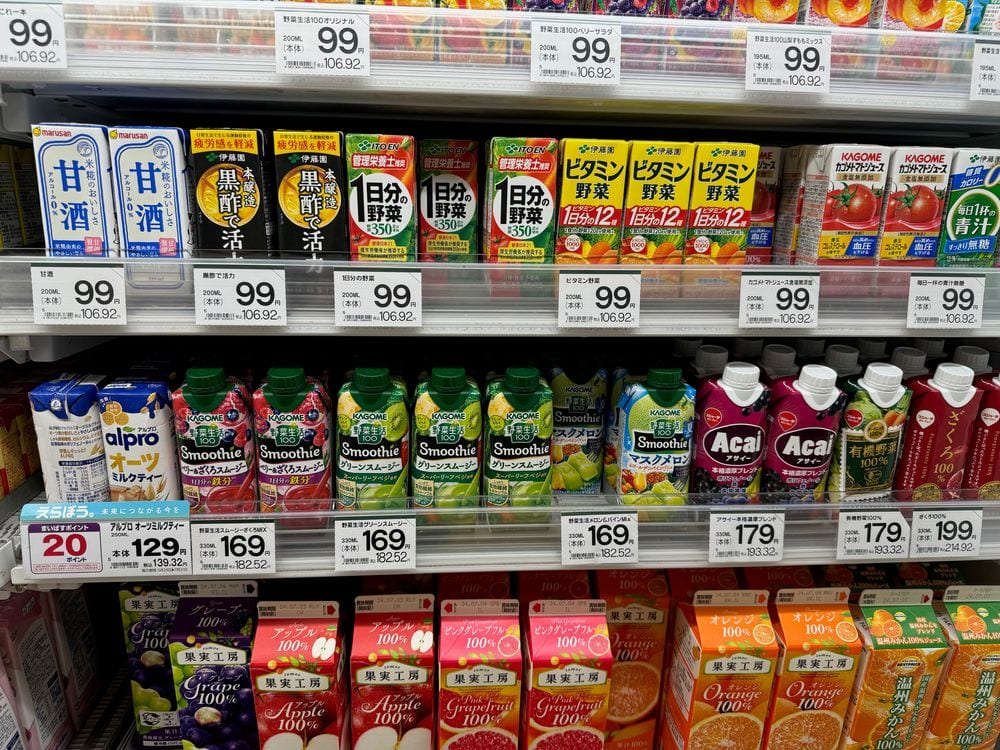
We stopped into a neighborhood supermarket in Shibamata, a quiet old-town corner of Katsushika in eastern Tokyo, and the cold-drink shelf ended up being the most useful photo from that whole visit. Every product on it carries its own bright yellow price tag, which makes it a real, unstaged answer to a question that’s hard to pin down otherwise: what ordinary drinks cost at a Japanese supermarket, not a vending machine, not a souvenir shop, just a regular shelf a local family shops from.
The shelf, tag by tag
Top row, all priced at 99 yen: amazake, the sweet fermented rice drink sold cold in summer, in two varieties, alongside a run of vegetable and vitamin juice cartons branded around “one day’s worth of vegetables,” the kind of drink that shows up in Japanese lunch boxes and on office desks everywhere. That’s under a dollar a bottle for a category of drink that gets marketed everywhere else as a health product with a matching price tag.
Middle row, priced at 169 yen: a run of fruit smoothies, including an alpro plant-based bottle and several house smoothie varieties in green apple and mixed-fruit flavors. The two açaí bottles at the end of that row step up slightly to 179 yen, the small premium fruit blends like açaí tend to carry over plainer smoothie flavors even at supermarket prices.
Bottom row, mostly obscured by the angle of the shot but legible enough: fruit juice cartons running closer to 199 yen, and a small member-discount tag showing a lower price for shoppers with the store’s point card, a common enough feature of Japanese supermarket pricing that it’s easy to miss if you’re not looking for it.
How that stacks up against a vending machine
Japan’s roughly five million vending machines are the default way most visitors buy a cold drink, and that convenience carries a real cost. A standard 500ml bottled drink from a vending machine or convenience store now typically runs 130 to 210 yen, with major brands like Coca-Cola, Suntory, and Itoen having pushed some 500ml PET bottles past 200 yen after a run of price increases through 2025. Buying the same category of drink from a vending machine or convenience store instead of a supermarket can run 40 to 50 percent more for what is often the exact same product, same brand, same bottle, just a different shelf.
None of that makes vending machines a bad deal, they’re everywhere, they never close, and paying a premium for a cold drink on a hot sightseeing day is a completely reasonable trade. It just means the 99 yen amazake on this shelf isn’t really comparable to anything you’d grab on the street corner outside a train station, it’s the local price, not the tourist price, and the gap between the two is bigger than it looks until you see both tags side by side.
Why the gap exists in the first place
The price difference isn’t a mystery once you think about what each type of store is paying for. A vending machine has to cover the cost of the machine itself, the electricity to keep it running around the clock, and someone driving a route to restock it, often for a handful of bottles sold per stop. A convenience store is usually sitting on some of the most expensive real estate in the neighborhood, right outside a train station exit, staffed twenty-four hours whether or not anyone’s buying anything at 3 a.m. A supermarket like the one in Shibamata carries none of that overhead per bottle: it’s ordering by the pallet, it’s usually a few minutes’ walk off the main foot-traffic street where rent is cheaper, and a cold-drink aisle is one small part of a much bigger weekly grocery run rather than the entire product. None of that is unique to Japan, it’s the same reason a gas station soda costs more than a grocery store six-pack anywhere else, but the gap is easy to forget about mid-trip when a vending machine is right there and a supermarket isn’t.
Why we were in Shibamata at all
Shibamata isn’t a neighborhood most first-time visitors to Tokyo ever hear about, and that’s part of what makes it worth the trip. The area grew up around Taishakuten, a Buddhist temple founded in 1629, and it’s best known in Japan as the hometown of Tora-san, the fictional traveling salesman at the center of “Otoko wa Tsurai yo,” a film series that ran fifty movies deep between 1969 and 2019. The old shopping street leading to the temple still has the low-rise, retro character the films made famous, a deliberate contrast to the high-rise density most of Tokyo runs on. We didn’t come away with a full set of photos from that stop, a supermarket run on the way through isn’t the kind of thing anyone thinks to document in the moment, but the one photo we do have says something real about the neighborhood anyway: a normal shelf, at normal prices, in a part of Tokyo that isn’t performing for tourists.
Why this is worth knowing before a trip
A single price tag doesn’t change a travel budget. A pattern of them does. A family working through a two or three week Japan trip buying drinks at convenience store prices the entire time is spending close to double what the same drinks would cost from even one supermarket run a day, and that gap compounds fast across three kids who each want their own bottle. It’s not a reason to avoid convenience stores, their location and hours are worth the markup plenty of the time, it’s a reason to keep at least one supermarket stop in the rotation on longer stays, especially anywhere outside the densest tourist corridors where a Life, a Maruetsu, or a small local shop like this one in Shibamata is usually a short walk from wherever you’re staying.