Is the Tokyo Fire Museum Worth a Stop With Kids?
A free museum in Yotsuya with a basement full of vintage fire trucks and a rooftop helicopter kids can climb into. Real photos, real history, and a verdict.

Published on 8 min read
On this page
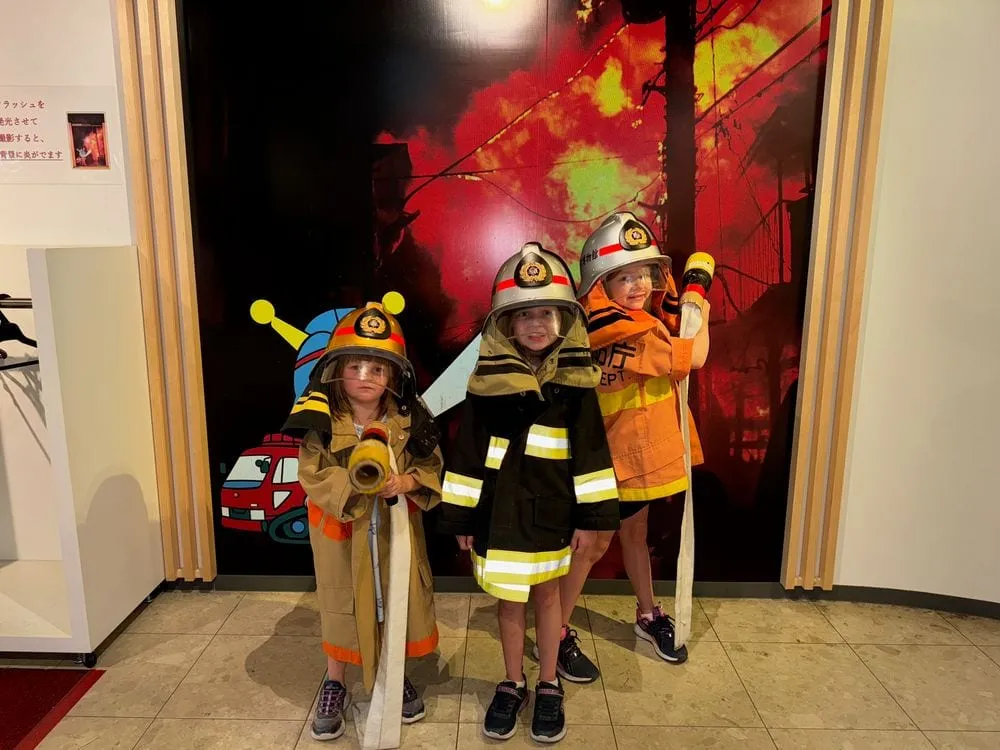
We ended up at the Tokyo Fire Museum almost by accident, a stop wedged into a June 2024 afternoon because it sat right on top of a subway exit we were already passing through. Three kids, a vintage fire truck, and a climb-in helicopter later, the question worth answering isn’t whether it’s free, it is, it’s whether a museum that small is worth planning around on purpose.
What it costs and how to get there
Admission is free, no ticket counter, no timed entry, no line. The museum sits at 3-10 Yotsuya in Shinjuku ward and connects directly to Exit 2 of Yotsuya-sanchome Station on the Tokyo Metro Marunouchi line, close enough that you can go from subway platform to the museum lobby without stepping outside. It’s open 9:30 AM to 5:00 PM, last entry 30 minutes before close, and closed Mondays along with occasional maintenance days, worth checking before a special trip since there’s no ticket to fall back on if the doors turn out to be shut. None of that upfront cost changes the calculation much, this is a zero-yen stop either way, but the free admission is exactly why the real question is about time rather than money: is an hour here worth spending on a Tokyo trip where every other hour is competing with somewhere else on the list.
The basement: fire trucks across a century
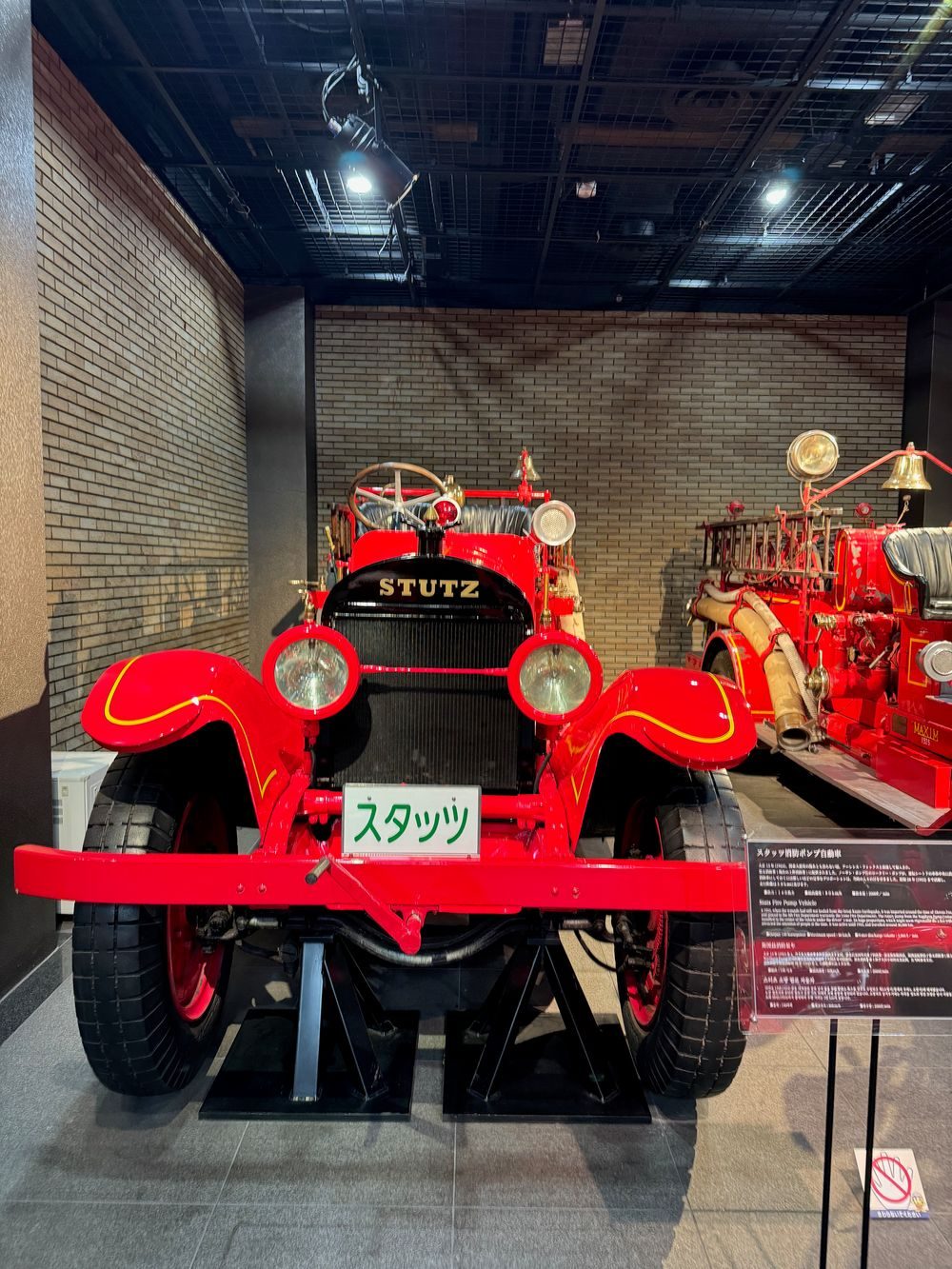
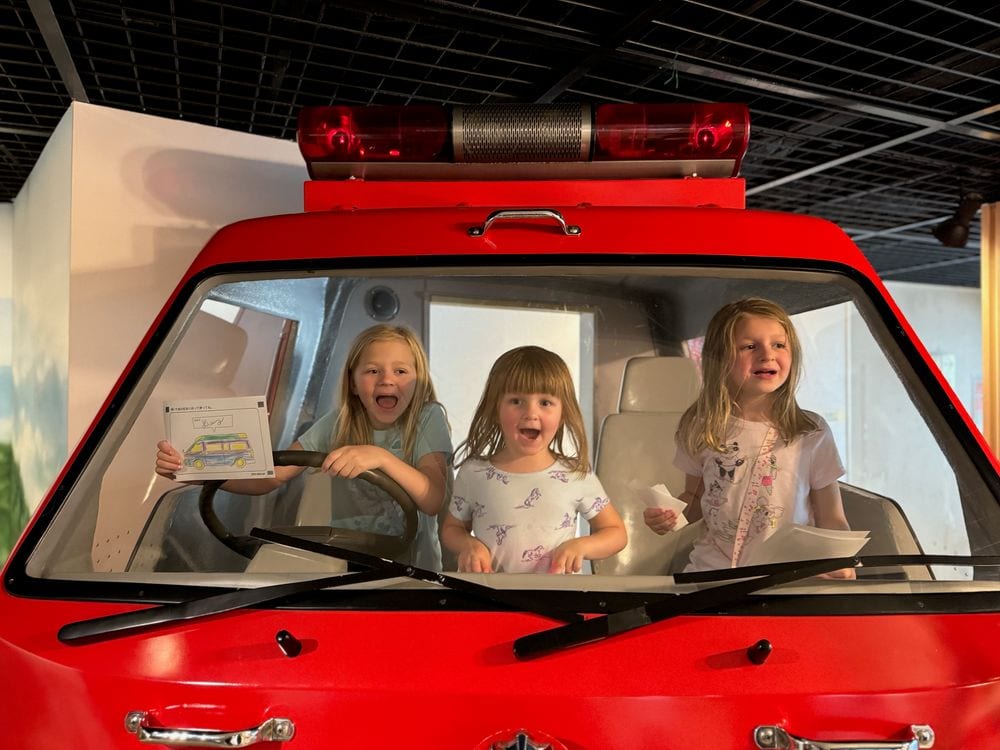
The trucks are the first thing that grabs a kid’s attention, and they’re not roped off behind glass the way a lot of transportation museums handle their vehicles. Our photos show a vintage STUTZ engine, one of several historic trucks on display that trace firefighting equipment from the Taisho era through the Heisei era, meaning the collection spans roughly the 1910s through the early 2000s in a single room. Seeing a fire truck’s evolution across nearly a century, from an open-cab, hand-crank-era vehicle to something recognizably modern, does more to explain how firefighting technology changed than a wall of text ever could, and for three kids under 10, climbing partway into an open cab does more than reading a placard next to a truck they can’t touch.
The history most visitors skip past
Past the trucks, the museum’s other collection is nishiki-e woodblock prints and historical documents tracing firefighting back to the Edo period, and it’s worth slowing down for even with three kids pulling toward the next exhibit. Tokyo’s firefighting history starts in 1629, when the Tokugawa shogunate organized the first formal brigades, made up of samurai assigned to protect specific districts. By 1718, the shogun Tokugawa Yoshimune expanded the system with townspeople brigades, known as machi-bikeshi, to cover the wider city, and by 1738 Edo had more than 11,000 firefighters protecting a city of roughly a million people, a ratio that would be considered remarkable by any modern city’s standards.
What those Edo-era brigades did looks nothing like modern firefighting. With a city built almost entirely of wood and paper, and no real water pressure system to speak of, the standard tactic wasn’t dousing flames, it was tearing down the buildings in a fire’s path to create a gap it couldn’t cross. Fires were common enough, and dramatic enough to watch, that Edo residents coined a grimly cheerful saying for them: “kaji to kenka wa Edo no hana,” fire and fighting are the flowers of Edo, a line that treated the city’s near-constant blazes as a kind of dark civic spectacle rather than pure catastrophe.
Each brigade carried a matoi into that spectacle, a tall decorated standard topped with a distinct emblem unique to that unit, and raised it as close to the fire as anyone dared. The matoi worked as both a rallying point for the crew and a signal to everyone else in the smoke-filled streets about which brigade was already on the job, and whichever brigade’s matoi went up first at a fire earned the right to claim it as theirs to fight, turning firefighting into something with its own competitive honor system. Ukiyo-e artists, including masters like Hiroshige, turned these firefighters into folk heroes in their prints, painting them with the same dramatic energy usually reserved for samurai in battle, and a handful of those prints are part of what’s on display in the museum today, tucked in among cases of preserved firefighting gear from the same period.
The rooftop helicopter
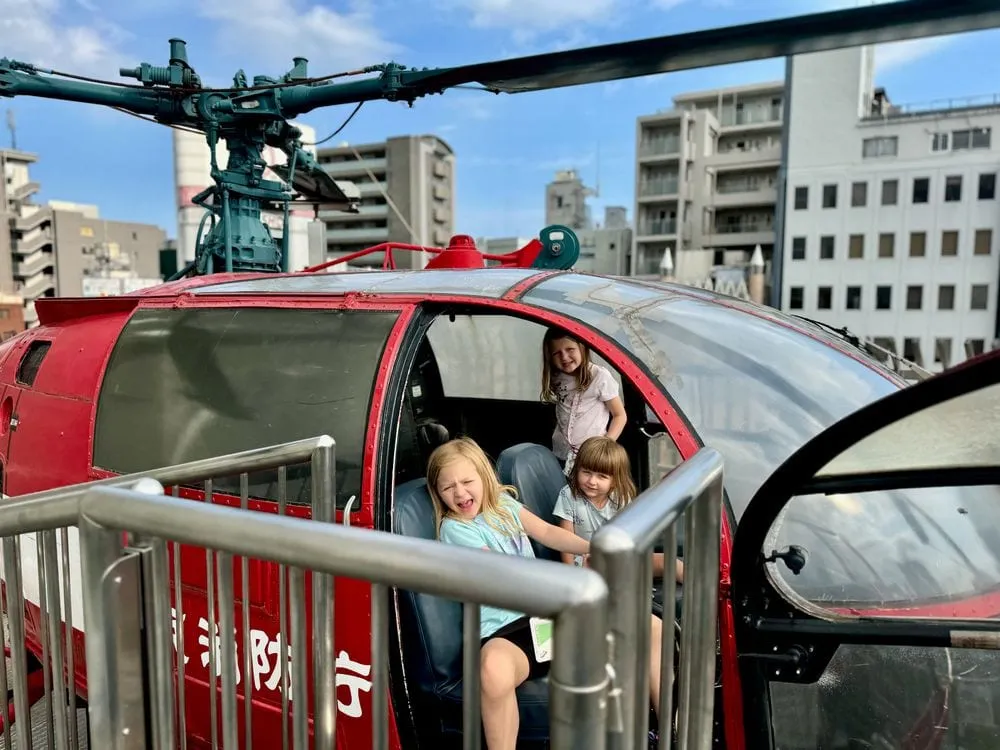
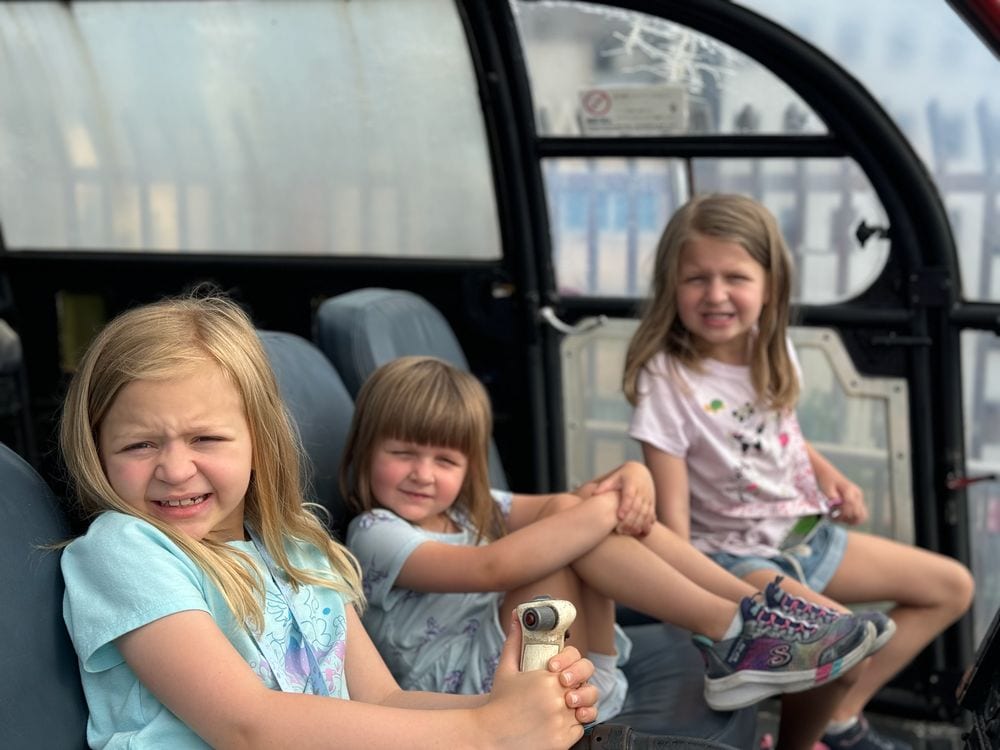
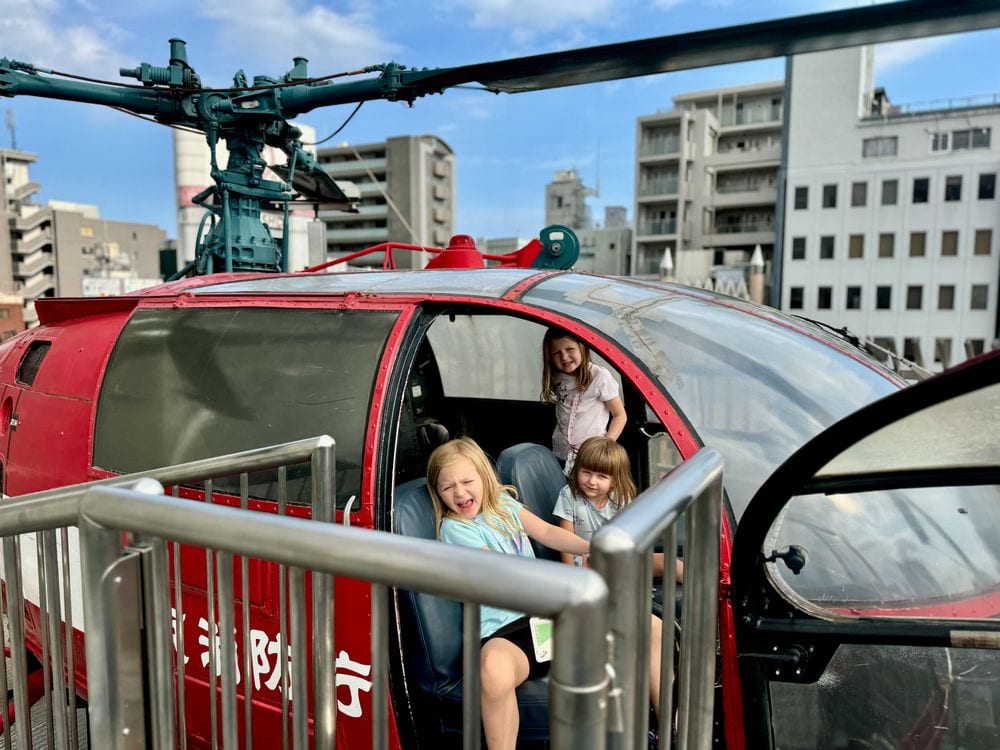
The other favorite stop, by a wide margin, is on the roof: a real fire department helicopter kids can climb directly into and sit in the cockpit seats. It’s a small thing on paper, a stationary aircraft with the interior open for visitors, but it’s the kind of exhibit that turns “we’re going to a museum” from a chore into something a 6, 8, and 9-year-old will ask to go back to. There’s no separate ticket or time slot for the rooftop, it’s included in the same free admission as everything else, and it tends to be where a family ends up spending more time than planned, the girls climbing in and out of the cockpit long after we’d have moved on from a display case downstairs.
Visiting with kids of different ages
We had a 6, 8, and 9-year-old with us, and the museum handled that spread of ages without any of the three losing interest at different points, which isn’t a given at most small museums built around a single narrow theme. The youngest was happy just climbing through vehicles, the older two read enough of the history panels to start asking real questions about the matoi banners and why Edo burned down so often, and none of it required us to split up or fast-track anyone through a section that wasn’t holding their attention. The facility itself is built for a range of visitors too: wheelchair ramps and an elevator connect the floors, restrooms include diaper-changing facilities, and wheelchair rental is available at no cost, the kind of practical accessibility detail that’s easy to take for granted until a stroller or a stiff knee makes a museum’s stairs the deciding factor in whether a stop is worth it. Most of the exhibits carry English-language explanations alongside the Japanese, which matters more here than it would at a bigger, better-funded museum, since a small municipal facility like this one has no obligation to translate anything for foreign visitors and plenty in Tokyo simply don’t. Not having to stop every few minutes to read a translation app screen over a kid’s head is its own kind of value on a free attraction, one that doesn’t show up in any price comparison but shapes how much of the museum a non-Japanese-speaking family gets out of the visit.
How long it runs, and where it sits against other small museums
This isn’t a half-day museum, and it isn’t trying to be. Most visitor accounts put the whole visit at around an hour, and that tracks with our own afternoon there: long enough to see the trucks, read a handful of the history panels, and let the kids climb through the helicopter twice, short enough that it never became the kind of museum visit where younger kids start melting down by the second floor. That makes it a useful shape of stop for a family itinerary, not a destination to build a whole day around, but a free hour that slots in easily next to something else in Shinjuku, timed around a subway transfer rather than around the opening and closing hours a bigger paid attraction would demand.
Small, specialty museums like this one are common across Tokyo, and most of them aren’t free. The Tokyo Metro Museum out in Edogawa, which we’ve written about separately, charges 220 yen a person, a small number by any standard, but still a real ticket line and a real price tag three kids’ worth of admission adds up against. A lot of Tokyo’s smaller municipal and specialty museums sit somewhere in that 200 to 500 yen range: enough to matter when you’re stacking five or six stops into a single day, not enough to skip on its own. The Fire Museum sitting at exactly zero, with no ticket counter to queue at either, makes it something of an outlier in that category rather than the norm, and that’s worth knowing before assuming every small museum in the city runs the same way.
Was it worth it
Yes, and by a wider margin than “it’s free” alone would suggest. A free museum that turns out to be forgettable still costs you the hour you spent there, and plenty of small municipal museums are exactly that kind of forgettable. This one isn’t. The trucks are real and touchable rather than roped off, the history is more interesting than a firefighting museum has any obligation to be, and the helicopter is the rare free exhibit that competes for a kid’s attention against anything paid nearby. We didn’t plan the stop, it fell into place because of where the subway exit happened to put us, and it’s still one of the more memorable hours from that stretch of the trip, which is a better result than plenty of attractions we did pay for. If there’s a lesson in that beyond the museum itself, it’s that a Tokyo itinerary built entirely around the big paid stops, the theme parks, the observation decks, the ticketed museums, can end up skipping the exact kind of place that ends up sticking with three kids the longest: something small, hands-on, and free enough that walking in on a whim costs nothing if it turns out not to land.